


There was a time when students aiming to study commerce at the college level had only one choice- B.Com! Today, not only do they have the option to study BBA besides B.Com, but they also choose various specialisations under BBA.
So, which of these two broad streams suits you – B.Com or BBA? This blog discusses the broad aspects of these two courses, including course content, scope and job opportunities. Remember, both these degrees could pave the way to lucrative careers in business management and finance. However, they differ fundamentally in curriculum, learning approach, skill development and the career prospects they offer.
Continue reading to grasp the basic formats of these two courses so that you can get an idea which of the two suits your career preferences.
BBA and B. Com- Course Overviews
BBA in Business Management
This course is a professionally designed UG degree course that aims to inculcate entrepreneurial and business managerial skills in students to enable them to conduct business with practical insights in real-world circumstances.
The course focuses on core business areas such as entrepreneurship and management skills, business planning and strategy, sales and marketing, organisational behaviour and human resource management and operations and supply chain.
The BBA programme emphasizes on practical learning approach that includes real-world case studies, seminar presentations, internships and group projects.
Visit our Courses Page Here.
B.Com (Bachelor of Commerce)
B.Com, on the other hand, is a traditional UG degree course on commerce that teaches students subjects related to theoretical and technical aspects of commerce, accounting and finance.
The course is aimed at building a strong foundation on accountans, finance, business laws, costing, taxation and financial management.
These subjects include fundamental accounting concepts, business management, commercial laws, business mathematics and statistics, higher accounts and financial/corporate management. The teaching-learning approach is largely theoretical.
B.Com is particularly suitable for students interested in finance-oriented careers or those planning to pursue professional qualifications like CA, CS, or CMA.
See how BBA in Business Management focuses on practical, industry-ready learning
Course Duration and Eligibility
COURSE COMPARISON | BBA | B.COM |
Course Duration | 3 years | 3 years |
Course Eligibility | 10+2 from any stream (Commerce preferred) | 10+2 with Commerce (usually mandatory) |
Admission Process | Merit-based / Entrance exams | Mostly merit-based |
BBA programs are often open to students from all streams, while B.Com usually requires a commerce background.
Curriculum Comparison
As stated, the BBA curriculum stresses practical business management concepts with a strong focus on leadership, management, entrepreneurship and marketing. The B. Com course curriculum, on the other hand, emphasises finance, accounting, taxation banking and commercial laws. BBA graduates aim for managerial functions while B. Com graduates performing accounting, finance and banking roles. Both BBA and B.Com graduates can also pursue higher education, with BBA degree holders having the option to pursue an MBA, while B.Com graduates can opt for an M.Com or CA.
Teaching Methodology and Learning Approach
BBA | B. Com |
Leadership/ Managerial training
| Theory paper-based exams
|
Case Study Analysis
| Numerical problem-solving
|
Skill Development Assignments
| Lecture-based teaching-learning
|
Internships and Industry Tours
| In-depth Academic Studies and Research
|
Seminar presentations and Group projects
| Dissertations |
BBA will suit you better if you prefer interactive and practical learning, while a B.Com is the right fit for you if you like numbers, theory, and structured study.
Prefer hands-on learning? Explore BBA programs designed for practical exposure
Career Opportunities - Comparing BBA with B. Com
BBA in Business Management
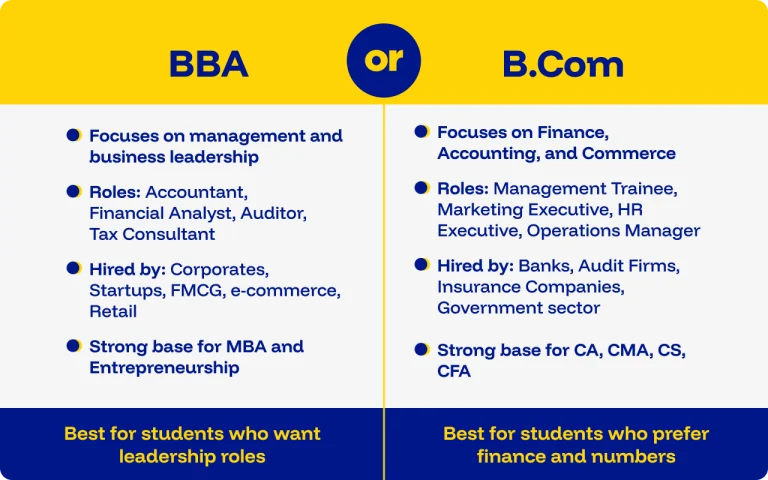
BBA graduates are trained for managerial and leadership roles from the start of their careers. Most begin as Management Trainees and grow into positions such as Business Manager, Marketing Executive, Sales Manager, HR Manager, Operations Manager, or Project Coordinator.
BBA graduates are highly valued in corporate firms, startups, SMEs, FMCG companies, e-commerce platforms, retail chains, consulting firms, and multinational organisations. The degree is ideal for students who want to work in dynamic business environments, take up people-management roles, or move towards entrepreneurship and an MBA.
B.Com (Bachelor of Commerce)
B.Com graduates mainly build careers in finance, accounting, taxation, and commerce-related roles. Common job profiles include Accountant, Financial Analyst, Auditor, Tax Consultant, Banking Executive, Accounts Officer, and Compliance Executive.
They are typically hired by accounting and auditing firms, banks, insurance companies, financial institutions, corporate finance departments, and the government sector (such as audit, accounts, and taxation services). B.Com is well-suited for students who want to specialise in finance or pursue professional qualifications like CA, CMA, CS, or CFA.
See how Inspiria prepares BBA students for managerial careers through internships and placements.
Salary Ranges
BBA | B.Com |
Entry-level salary: ₹3–6 LPA | Entry-level salary: ₹2.5–5 LPA |
Mid-level (with MBA): ₹8–15 LPA | With CA/CS/CMA: ₹7–20+ LPA |
Senior management roles: ₹20+ LPA | Senior finance roles: ₹25+ LPA |
Salaries also depend on the sector and the specific job role.
BBA vs B.Com – The Final Decision Lies with You
There is no finality in the answer to this critical question. Once you have read this blog, it is upto you to decide and the decision is based on your interests, career goals and learning style.
- BBA in Business Management is for you if you prefer a dynamic, managerial career.
- Choose B.Com if you aim develop expertise in finance, accounting and commerce.
Any of the above two degrees will offer excellent job opportunities when combined with the right skills, internships, and higher education. Whatever you choose, you have to be dedicated and sincere in your studies.
Not sure which course suits you? Get expert career guidance

Conclusion
In conclusion, we can say that it would be wise to focus on getting the right education that will enable you to obtain the necessary skills. A degree on paper is not enough – it is what knowledge and capabilities you have gained that is more crucial. Success in today’s cut-throat job market depends on how well students use their education rather than just their degree. Irrespective of your degree – whether it is a BBA in Business Management or a B.Com, the important thing is to develop useful and relevant skills, get exposure to the real world, and consistently expandyour knowledge. Making an informed choice now can set the stage for a fulfilling and prosperous career later on.