


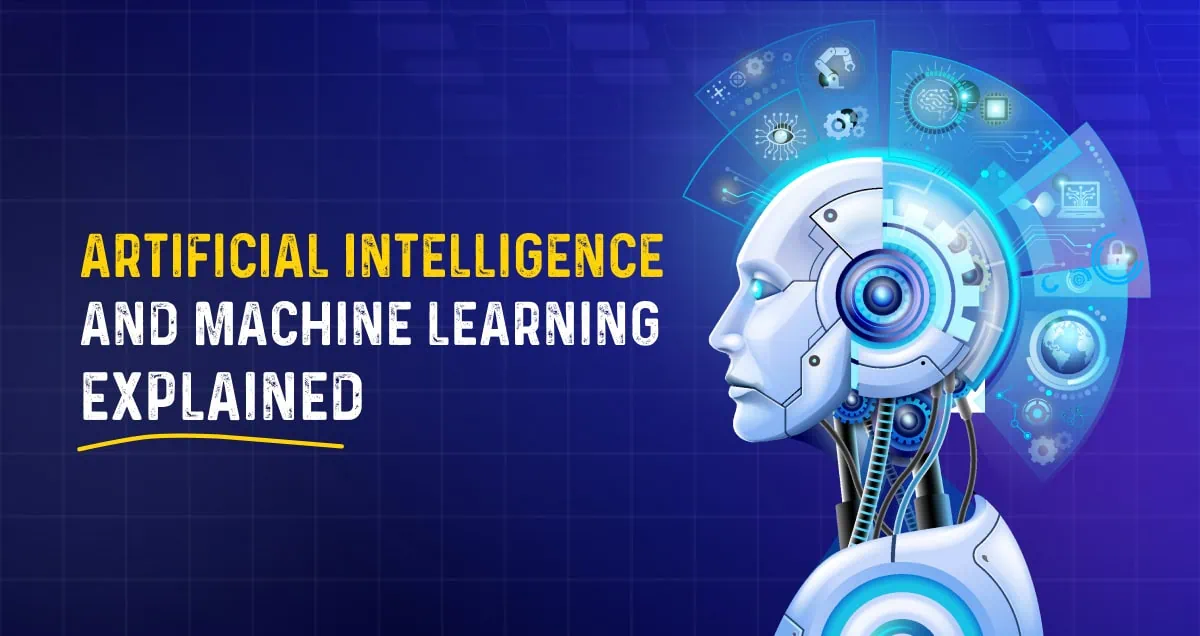

Among all the emergent technologies today, Artificial Intelligence (AI) and Machine Learning (ML) are taking the world by storm. AI and ML are rapidly transforming the way we humans live, work, interact with each other and conduct business. They are transforming business and industries in a manner and on a scale one could have never imagined. For young students seeking to make a mark in the future, it is extremely vital to achieve a basic understanding of these game-changing technologies as they will play a decisive role in how their career shapes up. In this blog, we shall break down into easy, understandable language on the foundation concepts of AI and ML so that students can comprehend how these technologies work and how they are likely to transform career roles in the near future.
What is Artificial Intelligence?
Simply speaking, Artificial Intelligence (AI) refers to a specialized area of computer science where advanced computational systems perform tasks that need human intelligence such as problem-solving, understanding natural language, decision-making and even reasoning. In short, AI imitates human behaviour and thinking. AI depends on several other core technological systems to perform human-like tasks. By analyzing huge data sets, AI recognizes patterns to make predictions to improve the efficiency and performance of tasks.
Typical examples of AI operations are:-
- Chatbots, including highly advanced chatbots such as ChatGPT
- Facial recognition systems
- Virtual assistants (Alexa and Siri)
- Autonomous vehicles
- Smart home devices
What is Machine Learning?
As a branch of Artificial Intelligence (AI), Machine Learning (ML) enables computers to “learn” from data, analyze patterns and make decisions. ML goes a step ahead of traditional computing which is totally dependent on programmed tasks. In traditional computation, computers could do no more than follow the exact instructions written by programmers. ML goes a step ahead of traditional computing which is totally dependent on fixed, pre-set programmed tasks, to identify patterns and accomplish complex tasks. Machine learning enables systems to improve automatically with usage.
👉 Want to build a career in AI? Explore our BCA in Artificial Intelligence & Machine Learning and gain industry-ready skills.
Difference Between AI and ML
People are often confused with the terms AI and ML and often think they are synonymous. Actually they are not the same. ML is a sub-set of AL and there is a fine but definite distinction between the two. Artificial Intelligence is the broad area of computation that mimics human intelligence while Machine Learning is a specialized area, within AI, that empowers machines to deliver better performance by “learning” from data. Machine Learning is one of the driving forces of Artificial Intelligence.
Why Should Students Learn AI and ML?
AI and ML have become indispensable in every major sector such as business, finance, agriculture, healthcare, transportation, education, and entertainment. Students with a fundamental understanding of AI and ML will become more job-ready for the future where these technologies will define career roles. The reasons why it is vital to learn the basics of AI and ML are cited below: –
- Increasing Career Scope: As stated AI and ML are transforming business and industries in a manner no one could have predicted. As a result, there is a huge demand for skilled AI professionals to work as AI Engineer, Data Scientist, ML Engineer, Data Analyst and AI researcher.
- Problem-Solving Skills: Mastery in AI and ML skills develops logical thinking and problem solving skills among students.
- Boosts Creativity and Innovation in Students: Using AI, students learn how to create new, innovative tools and build smart applications. This boosts their innovation skills and allows them to devise creative solutions for complex problems.
- Understanding Modern Technology: Through a thorough understanding of emerging technologies like AI and ML, students gain deeper insight into the latest technologies and become informed digital citizens.
ML – A Step-by-Step Process
Though the systems that run Machine Learning are highly complex and advanced, these follow the following steps: –
- First Step -Data Collection: ML has no meaning without data, indeed data is the foundation of Machine Learning. The sort of data that is collected includes text, images, numerical data, audio and video. The bigger the data and higher the quality of the data, the better is the performance of the ML model.
- Second Step – Data Preparation: It is necessary to clean, process and organize the data before training a model as raw data can be messy. Data Preparation process includes (i) removing errors (ii) Filling up the data gaps (iii) Categorizing the data (iv) Preparing the data to make it usable.
- Third Step – Model Training: In this step, the ML algorithm analyses the data and discerns the notable patterns. For example, the data patterns relating to a weather system enables prediction of rainfall, or a music app reveals the preferred songs of the user or even data relating to a spam filter reveals which emails are spam. The better the algorithm, the better is the accuracy.
- Fourth Step – Model Testing: Once training is completed, new data (unknown to the model) is fed into the model to ascertain the accuracy in its prediction ability.
- Fifth Step – Prediction Making: After successful training, the model is able to make correct predictions in real-world situations such as speech and language recognition, disease detection, or stock price trend depiction.
Types of Machine Learning
Machine learning, as explained in the following table, is broadly categorised into three main types.
| TYPES | Learning Process | Examples | Common Applications |
| SUPERVISEDLEARNING | The model learns from labelled data, which means the correct answers are already provided. | (i) Predicting exam results based on study hours (ii) Identifying spam emails | (i) Fraud Detection ii) Email segregation (iii) Image recognition |
| UNSUPERVISED LEARNING | The system tries to find hidden patterns or relationships on its own from unlabeled data. | (i) Segregating customers with common shopping habits (ii) Identifying social media data trends | (i) Customer segmentation (ii) Analysing data (ii) Recommendation mechanisms |
| REINFORCEMENT LEARNING | Here the ML system learns by trial and error. It is rewarded for accuracy and penalized for errors. | (i) Robot Training (ii) AI Gaming | (i) Self-driven vehicles (ii) Advanced Gaming |
👉 Discover how our industry-aligned curriculum combines theory, practical learning, and real-world AI projects.
Fundamental Ideas of AI and ML
It is important for students to acquaint themselves with the following fundamental concepts of AI and ML: –
- Algorithms: A complete set of instructions to accomplish a task or solve a problem is called an algorithm. ML algorithms enable computers to learn from data. Algorithms may be in the form of linear regression, decision trees, K-Means clustering and Neural networks.
- Neural Networks: Based on the highly complex human brain structure, Neural networks consist of multiple layers of connected nodes that enable information processing. They are widely used in image differentiation, speech identification and language translation.
- Data Science: The knowledge of data collection, analysis and interpretation to extract meaningful and useful information is called Data Science. Data Science acts as the foundation of AI and ML.
- Big Data: Huge data sets that cannot be manually handled are called big data. AI systems require big data to deliver optimized and more accurate results
- Natural Language Processing (NLP): NLP enables the understanding and processing of human language. This is used in language translation, chatbots, voice assistant services and text summarization.
Real-World Applications of AI and ML
AI and ML are already being used in many industries as the following table illustrates: –
| Sector | Real-World Application |
| Healthcare | Disease diagnosis, Medical scans and report analysis, and personalized treatments |
| Finance | Detection of fraud, assessment of credit risks, and automation of customer service |
| Education | Personalized learning experiences best study material recommendation. |
| Agriculture | Crop monitoring, weather predictions and improved productivity |
| Transportation | Self-driven vehicles and intelligent traffic systems |
| Entertainment | Recommendation of movies, music, and videos based on user preferences |
AI/ML Skills that Students Should Pick Up
- Critical Thinking: Critical thinking needs to be highly developed.
- Programming: Students must learn Python which is extensively used in AI & ML.
- Communication Skills: Students must have solid language and communication skills.
- Mathematics: Master in probability, statistics and algebra is a huge help, especially to comprehend algorithms.
- Data Analysis: Basic knowledge of data analysis is a must.
👉 Ready to start your AI journey? Apply for our BCA in Artificial Intelligence & Machine Learning today.
Conclusion
AI and Machine Learning are transforming the world quickly. These technologies enable machines to acquire knowledge from data, make choices, and execute tasks that previously required human intelligence.
For students, grasping the basics of AI and ML is necessary nowadays. This is beneficial not only for future AI/ML professions but also for all students for a better understanding of the digital environment they inhabit. Students can establish a solid groundwork for future research and innovation by understanding fundamental concepts like algorithms, data, neural networks, and machine learning models. AI and ML might appear intricate initially, yet through curiosity, practice, and ongoing education, students can delve into these fascinating domains and join the upcoming wave of innovators and problem-solvers.
FAQs:-
ANS:- AI is the broader concept of creating intelligent systems that mimic human intelligence, while Machine Learning is a specific area within AI that enables machines to learn from data and improve their performance over time.
ANS:- AI and ML are used in healthcare for disease diagnosis, finance for fraud detection, education for personalized learning, agriculture for crop monitoring, transportation for intelligent traffic systems, and entertainment for content recommendations.
ANS:- The three main types of Machine Learning are Supervised Learning, Unsupervised Learning, and Reinforcement Learning. Each type uses different methods to learn from data and solve problems.
ANS:- Students should develop skills in programming (especially Python), mathematics, statistics, data analysis, communication, and critical thinking to build a strong foundation in AI and ML.
ANS:- Students with AI and ML knowledge can pursue careers such as AI Engineer, Machine Learning Engineer, Data Scientist, Data Analyst, AI Researcher, and other technology-focused roles across various industries.
ANS:- AI and Machine Learning may seem complex initially, but students can gradually build their understanding by learning programming, mathematics, and data concepts while practicing through projects and real-world applications.