


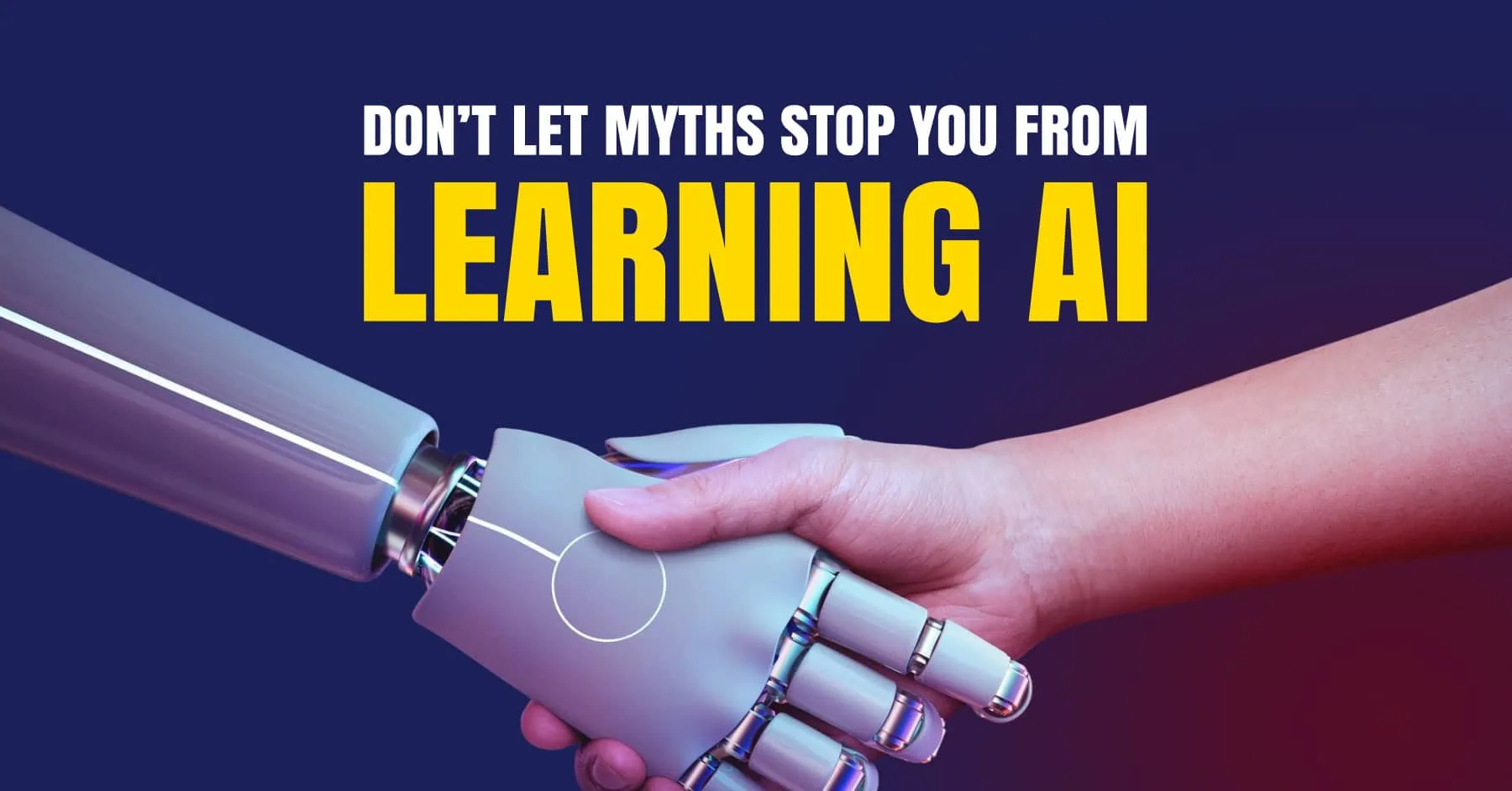

From chatbots helping you online with work and assignments to self-driving cars hitting the road, AI is everywhere. However, with the growing presence of AI, there’s a considerable amount of confusion, especially among students, surrounding it.
Myths about AI are stopping students from exploring this exciting field. Whether it’s thinking you need to be a tech genius or fearing AI will steal jobs, these myths create unnecessary roadblocks. In this blog, we’ll bust the most common AI myths and show you why diving into AI could be one of the best decisions you make for your future. Let’s get the facts right!
Confused about starting your AI journey? Learn from the facts — not the myths!
Top 10 AI Myths Students Believe — Busted
1. AI Is Only for Science Students
Many students believe that only science-background learners can pursue a career in artificial intelligence, but this is one of the most common myths about AI. In reality, students from all academic streams including Commerce, Arts, and Humanities can successfully enter the AI field with the right foundational training and learning approach.
While a background in subjects like mathematics can be helpful, it is not a strict requirement to get started. This is one of the key AI myths students should stop believing. For example, a student from a non-science background can begin by taking introductory courses in programming, machine learning, and data science. With consistent practice and skill development, they can later apply for AI-focused degree programs such as a B.Sc in IT with AI specialization.
What truly matters in artificial intelligence is curiosity, problem-solving ability, and a willingness to learn. With access to online resources, beginner-friendly courses, and hands-on projects, AI is an open and accessible field for anyone, regardless of their academic background.
Yes, commerce & arts students can do AI. Apply now to get started.
2. You Must Know Coding Before Learning AI
The truth is, most beginner-friendly AI courses, like a B.Sc in IT (AI), teach coding from scratch, so you don’t need to be afraid. These programs usually begin with the basics, like Python or logic building, which are essential for AI and data science.
Each semester will help you get a hold of AI. For example, learning how to code is one of the first things covered in the semester 1 curriculum, wherein you’ll only be introduced to programming fundamentals and problem solving. With the right guidance and consistent practice, anyone can learn to code, whether you’re starting from zero or refreshing your skills.
Don’t worry if you’ve never coded. We’ll teach you step-by-step. Check out our beginner-friendly curriculum.
3. AI Requires Advanced Math
You don’t need to be a math genius to work in AI. While math is involved, it’s not about mastering complex formulas from day one. Most AI concepts are built on basic algebra, logic, and problem-solving skills that anyone can learn with practice.
Real-world examples, like how recommendation systems suggest products or how AI can recognize faces, are used to teach these concepts, making the learning process more intuitive and less about crunching numbers. While advanced topics like calculus or statistics may come into play later in more specialized areas, they’re not required upfront. So, don’t worry, if you’ve got a solid grasp of basic math and a logical mindset, you’re good to go!
Our course makes AI math-friendly and practical. Join now.
4. AI Is Only for Big Tech Companies
That belief is simply incorrect, because AI is transforming industries across the board. This is one of the most common AI myths about students and learning. Artificial intelligence is no longer limited to the tech sector alone. Today, healthcare uses AI to diagnose diseases and predict patient outcomes, retail companies implement recommendation systems to deliver personalized shopping experiences, banks rely on AI to detect fraud and manage risk, and education platforms use AI to personalize learning paths for students.
In India, AI adoption is growing rapidly across both startups and government initiatives, further debunking AI misconceptions in education and career planning. For example, companies like ZestMoney are using AI-driven models to improve financial inclusion and credit accessibility. At the same time, the Government of India is actively leveraging AI in smart city development, traffic management, healthcare analytics, and disaster management systems.
With a B.Sc. in IT (AI), students can access internships, live projects, and placement opportunities across these diverse sectors. The scope of artificial intelligence is vast and continues to expand. With the right training, practical exposure, and mindset, students can build successful AI-driven careers in almost any industry they choose.

5. AI Will Replace All Jobs
The reality is, AI isn’t replacing jobs, it’s creating a lot more opportunities! According to the World Economic Forum, AI will create 170 million new jobs by 2025. These aren’t just tech-related roles either; industries are seeing demand for positions like AI Trainer, Prompt Engineer, Data Analyst, and even AI Ethics Specialist. The key is learning how to work alongside AI rather than being replaced by it.
Programs like B.Sc in IT (AI) are designed to teach you how to leverage AI tools to improve your skills and productivity, not just automate your job. By gaining a solid understanding of how AI works and how to apply it effectively, you’ll be in a great position to thrive in the AI-driven job market. The future isn’t about being replaced; it’s about collaboration with AI to drive innovation.
AI won’t replace you, but someone trained in AI might. Get skilled today.
6. AI Means Robotics Only
AI isn’t just about physical robots; it powers many of the software-based systems we use every day. From chatbots that assist with customer service, to search engines that help us find information, to voice assistants like Siri and Alexa, AI is behind these systems, making our lives easier and more efficient.
The key difference here is that AI refers to the technology that allows machines to learn and make decisions, while robotics focuses on building physical machines that can perform tasks. In your B.Sc in IT (AI), you’ll dive deep into software-focused AI, covering machine learning, natural language processing, and AI in applications like recommendation systems and predictive analytics topics that focus entirely on software, not robots.
Learn how AI is behind the apps you use daily. Start learning AI now.
7. You Need a High-End Laptop to Study AI
NO! You don’t need a high-end device to begin your AI learning! You can get started with just a basic laptop, using cloud tools and campus resources. In your B.Sc. in IT (AI) program, you’ll use tools like Google Colab, Jupyter Notebooks, and Python libraries to write and test code. These tools are free, accessible, and powerful enough for AI development.
Plus, many campuses offer state-of-the-art labs with the necessary infrastructure, including high-performance computers and cloud computing resources, to support your AI projects. So, whether you’re working from home or the campus lab, you’ll have everything you need to kickstart your AI learning.
We provide the tools — you bring the curiosity. Apply today
8. AI Is Too Advanced for College Students
AI might sound intimidating, but modern B.Sc programs are specifically designed to teach it at an undergraduate level, starting with the basics. The course structure is beginner-friendly, guiding you step by step through your learning journey.
In your first year, you will only study the fundamentals of learning programming, algorithms, and basic AI concepts like data structures. By the 2nd year, you’ll dive into tools and techniques, such as machine learning, Python programming, and data analysis. And in your 3rd and 4th year, you’ll apply what you’ve learned by working on real-world projects and exploring advanced applications like natural language processing and AI in business. With this gradual approach, AI becomes much more accessible, and you’ll feel confident as you advance through each stage of the course.
No experience needed — just a willingness to learn. Explore our AI program
9. AI Courses Are Too Expensive
Many people think AI courses are out of their budget, but the truth is, quality AI education is affordable and widely accessible, with plenty of options for financial aid and scholarships. For example, the course fees for the B.Sc in IT (AI) are much more reasonable compared to many specialized tech programs. Plus, there are scholarships available to help students based on merit or financial need, making it easier to get started without worrying about cost.
When you consider the return on investment, studying AI offers enormous potential. AI professionals are in high demand across industries like healthcare, finance, and tech, and the average salary for AI-related roles often far exceeds those of other fields. Investing in AI education now can lead to a rewarding, high-paying career in the future.
Don’t let budget stop your dreams. Apply for our AI program now.
10. AI Will Become Obsolete Soon
Far from becoming obsolete, AI is just getting started and is already the foundation of Industry 4.0, the next wave of technological advancement. AI’s impact is only going to grow. Automation, AI in healthcare (for better diagnosis and personalized treatments), AI in education (personalized learning experiences), and even ChatGPT (revolutionizing how we interact with machines) are just a few examples of how AI is reshaping industries and society. Far from being a passing trend, AI is a key driver of innovation that will continue to evolve and open up new career opportunities for years to come.

Why You Should Start Learning AI Now?
Now that we’ve busted the common misconceptions, it’s clear that artificial intelligence is accessible, affordable, and most importantly, full of opportunity. When you look at AI myths vs facts for students, it becomes evident that AI is not limited to science toppers, advanced mathematics experts, or experienced coders. Whether you come from a non-science background, have limited math exposure, or are just starting with programming, AI truly has space for everyone.
The demand for AI professionals is growing rapidly and will continue to rise as more industries adopt AI solutions across healthcare, retail, finance, education, and beyond. This shift makes artificial intelligence one of the most future-ready career paths for today’s students. The right time to begin is right after higher secondary education, when learning foundations are strongest and career options are wide open.
Starting early allows you to build core skills gradually, gain hands-on experience, and grow with the technology. With the right guidance, mindset, and consistency, students can step confidently into the future equipped with AI skills that will remain valuable for years to come.