


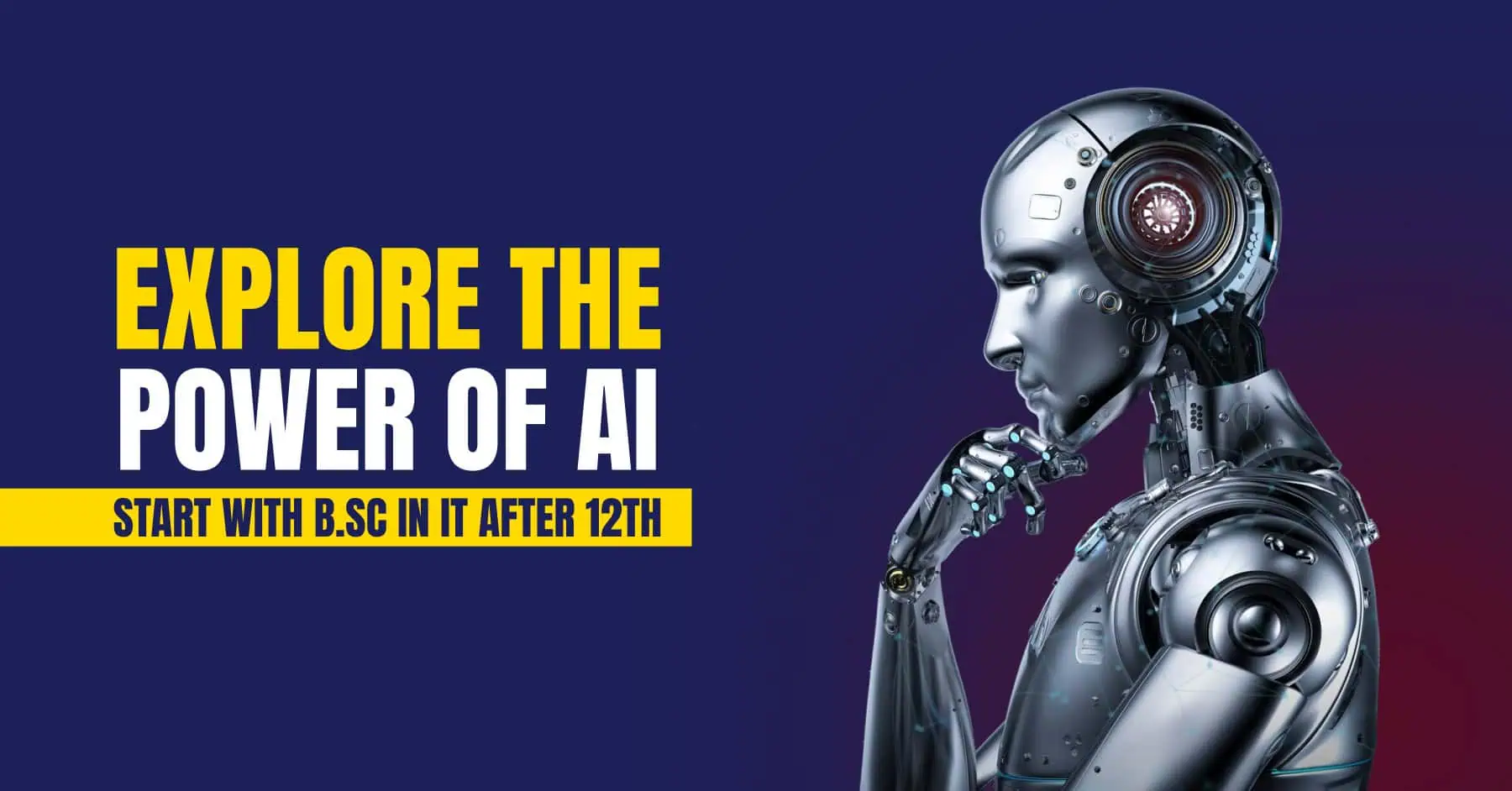

Artificial Intelligence (AI) is a fundamental component of the modern digital world and is no longer just a futuristic concept. From personalized Netflix recommendations to virtual assistants like Siri and Alexa, AI is transforming the way we live, work, and communicate. Understanding the latest developments in artificial intelligence has become essential for students pursuing a Bachelor of Science (B.Sc.), especially in Information Technology (IT). As part of the broader AI trends in 2026, artificial intelligence is now deeply integrated across industries such as healthcare, finance, education, agriculture, and manufacturing, not just limited to large technology companies.
As the AI era continues to evolve, it is critical for B.Sc. students to stay updated with emerging technologies and develop skills that align with industry needs. Keeping track of AI trends 2026 for B.Sc IT students helps learners prepare for future job roles, research opportunities, and advanced studies in AI-driven domains. From machine learning and data science to automation and intelligent systems, AI is reshaping career pathways at an unprecedented pace.
This blog highlights the most important AI trends in 2026 that every B.Sc student should know and explains how they can align their academic learning and career planning with these advancements to stay competitive in the evolving tech landscape.
Start building your AI future now. Explore our B.Sc in IT (AI) course
Why B.Sc Students Must Keep Up With Latest AI Trends
Staying updated with the latest AI trends offers B.Sc students a competitive edge in an increasingly digital job market. Here’s why it’s essential:
- Pertinence in the Employment Market: Companies are actively looking for experts with AI expertise. Students who stay up to date on current trends may find it easier to find employment.
- Foundation for Future Research: Gaining knowledge of cutting-edge AI principles provides a strong basis for any future research, including postgraduate studies and certifications.
- Research & Innovation: AI is a rapidly evolving discipline where new discoveries are made on a regular basis. Keeping up to date promotes creativity and research-based thinking.
- Entrepreneurial Opportunities: Students with AI insights can establish their own businesses or join innovative firms, as AI-driven enterprises are becoming more and more popular.
- Multidisciplinary Impact: AI has an impact on a wide range of fields, including economics, medicine, and biology. Students can use AI in transdisciplinary fields by staying current.
Knowledge of current trends is your career currency. Get hands-on with AI at Inspiria
Top 7 Latest AI Trends Every B.Sc Student Should Know
1. Generative AI
Content creation is being revolutionized by generative AI, especially models such as ChatGPT and DALL•E. These models can produce realistic photos and movies, compose essays, and write code. Students pursuing a B.Sc. should investigate resources such as RunwayML, Midjourney, and GPT-4 to learn how AI is boosting and automating creativity.
2. AI in Cybersecurity
AI is becoming increasingly important in identifying and stopping assaults as a result of the rise in cyberthreats. Data is analyzed by machine learning algorithms to spot irregularities and thwart attacks instantly. Network security-focused B.Sc. IT students need to investigate AI-powered cybersecurity technologies and methods.
3. AI in Healthcare
AI is being applied to patient monitoring, personalized medicine, medication development, and diagnostics. Healthcare is changing as a result of technologies like AI in genomics and computer vision in radiology. Biomedical IT students should keep a careful eye on these developments.
4. Edge AI
Running AI algorithms on devices (such as smartphones or Internet of Things devices) as opposed to depending on cloud computing is known as edge AI. Speed and data privacy are enhanced by this. Students pursuing a B.Sc. who are interested in mobile development or embedded systems might investigate Edge AI platforms like as Google Coral and NVIDIA Jetson.
5. Explainable AI (XAI)
The need to comprehend how AI models make decisions is increasing as they get more complicated. XAI seeks to increase the transparency and reliability of AI. Students should investigate resources like LIME and SHAP and comprehend the significance of ethics in AI.
6. AI-Powered Automation (AutoML)
Model development is becoming easier because to automated machine learning technologies like Google AutoML, DataRobot, and H2O.ai. Model selection, feature engineering, and hyperparameter tuning may all be automated with the aid of these tools. AutoML can help B.Sc. students who have little coding knowledge get started on actual projects more quickly.
7. AI for Sustainable Development
AI is being used to address global issues including sustainable energy, water management, and climate change. Machine learning is used by programs like Microsoft AI for Earth to improve agriculture and lessen its negative effects on the environment. Students that are enthusiastic about sustainability should pay particular attention to this intersection.
Click Here For AI in Cybersecurity: Top Career Paths After 12th
How B.Sc in IT Prepares You for These AI Trends?
Learning databases and programming languages is only one aspect of completing a B.Sc. in IT. It serves as a starting point for comprehending the relationship between intelligence and digital systems. The curriculum usually corresponds with the progress of AI in the following ways:
- Mathematics & Statistics: Fundamental to machine learning algorithms and data analysis.
- Programming Skills: Courses in Python, Java, or R are foundational for building AI models.
- Data Structures & Algorithms: Critical for understanding how AI algorithms work behind the scenes.
- Database Management: Essential for handling structured and unstructured data in AI projects.
- Project Work: Final year projects often allow students to implement AI applications like chatbots or recommendation engines.
- Electives in AI/ML: Many universities now offer specialized electives in artificial intelligence, machine learning, or data science.
These core areas ensure that B.Sc students are equipped to understand and adapt to the latest AI trends.

AI Projects & Certifications for B.Sc Students
Practical experience is vital in mastering AI. Here are some project ideas and certifications to boost your AI journey:
AI Project Ideas
- Chatbot for College Enquiries: Use NLP to create a chatbot that answers common student questions.
- Fake News Detection System: Use machine learning to identify fake news articles based on content features.
- AI-Powered Resume Screener: Build a tool that screens resumes based on job descriptions.
- Personalized Learning Assistant: A recommendation engine for study materials based on user behavior.
- Health Predictor App: Use machine learning to predict disease risks based on symptoms or habits.
Top AI Certifications
- Google AI Professional Certificate
- IBM AI Engineering on Coursera
- Microsoft Azure AI Fundamentals
- DeepLearning.AI’s Machine Learning Specialization (Andrew Ng)
- AWS Certified Machine Learning – Specialty
These certifications validate your skills and add credibility to your resume, especially when applying for internships or jobs.
Get future-ready skills with practical AI training. Apply Now for B.Sc IT (AI)
Career Opportunities After B.Sc in IT (AI)
A B.Sc degree with AI skills opens up various career paths. Some of the most promising roles include:
- Data Analyst: Interpret complex datasets to support business decisions.
- Machine Learning Engineer: Build predictive models and deploy them into production.
- AI Research Assistant: Work under research labs or academia to contribute to AI innovation.
- AI/ML Developer: Focused on coding and implementing AI algorithms into applications.
- Cybersecurity Analyst (AI Focused): Use AI to detect security breaches and prevent attacks.
- Computer Vision Engineer: Work in fields like facial recognition, surveillance, and AR/VR.
- AI Ethics Specialist: Focus on the responsible use and development of AI systems.
Many of these roles can be accessed directly after graduation or through internships, and they also serve as stepping stones to higher education (like M.Sc in AI or MBA in Data Science).
Know More About Highest Paying Careers After B.Sc IT
Final Thoughts – Your AI Journey Begins Now
Those who can effectively utilize AI will shape the future, and as a B.Sc. student, you are well-positioned to be part of this transformation. Whether your interests lie in coding, data analysis, automation, or solving real-world problems, artificial intelligence offers endless possibilities. As part of the rapidly evolving Generative AI trends 2026, technologies such as large language models, AI-powered content creation, and intelligent automation are opening new doors for innovation and growth.
For students aiming to explore AI career opportunities for B.Sc IT, the key to success lies in staying updated with emerging trends, building practical projects, earning industry-relevant certifications, and committing to continuous learning. Employers increasingly value hands-on experience with AI tools alongside strong theoretical knowledge.
To stay competitive, students should actively experiment with modern AI tools and project ideas for students, such as chatbots, recommendation systems, predictive analytics models, or automation-based applications. These projects not only strengthen technical skills but also enhance portfolios and job readiness.
Be consistent, start small, and stay curious. The AI ecosystem is vast and constantly evolving, but every step you take brings you closer to becoming a skilled professional, an innovator, or even a future leader in the AI revolution.