



You have just passed Class 12 boards, and have a creative mind? Then you may consider Interior Design as a prospective career. However, you may not have the basic knowledge about Interior Design, its prospects and career scope.
At the same time you may be somewhat confused regarding the career path you should take. Continue reading to clear your confusions and get the basic concept of Interior Design as a profession.
Introduction – Why Interior Design Basic Knowledge Matters After 12th?
It is not unusual to find students at a loss to find the right course after passing Class 12. They seem utterly confused, trying to understand what would suit them best for them. Add to this the family pressure factor. Often, due to family and peer pressure, students tend to sacrifice their passion and opt for a course due to practical considerations driven by job prospects.
The big challenge is to make an informed decision to avoid regretting later on in life. This is why it is essential to have a basic understanding of the various courses and streams offered in college, allowing you to balance your passion on one side with practical/family commitments on the other.
In this blog, we have tried to provide basic knowledge of the Interior Design course and explain its scope and career prospects. Awareness about the different courses at the college level will help you to save time and money while making the right career choice, and make you confident about your future.
What Is Interior Design?
Interior designing is all about beautifying spaces and making them more efficient and pleasant. Whether it is your bedroom or living room, your office space or your lawn and garden, interior designing ensures that you not only make optimum use of your spaces but also add aesthetic value with a sense of beauty and balance to them. Interior designers aim to make your indoor and outdoor spaces comfortable, aesthetically pleasing, and efficient. Planning layouts, designing the lighting, and adding the right furniture and materials are the core functions of interior design.
You will have noticed how the interiors of a plush restaurant seem so pleasant, graceful, and comfortable. This is because of the interior design knowledge behind their layout and space planning. The same is the case with residential spaces, offices, and college classrooms. Interior design ensures the ‘feel good’ factor in the spaces that you occupy.
👉 Explore interior design courses you can pursue after 12th
What Does an Interior Designer Actually Do?
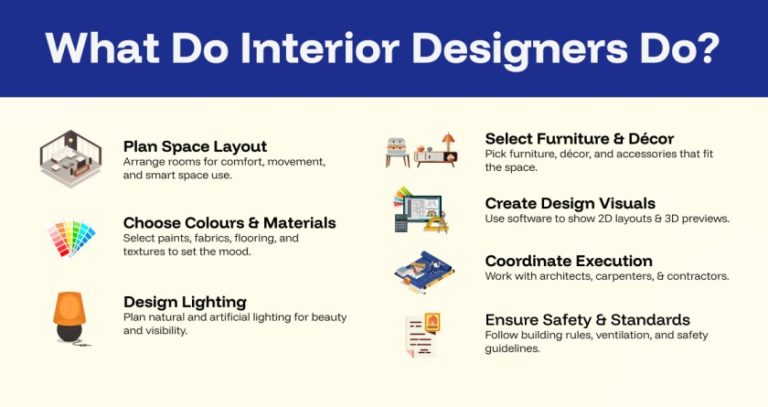
The job of an interior designer is to plan indoor spaces to optimize their functionality and make them comfortable and visually pleasant. They do this by:-
- Understanding a client’s specific requirements including his lifestyle and budget to deliver a comprehensive design idea for his office or residential space
- Interior designers plan layouts, apply colour theory, choose furniture, lighting and materials, to ensure a balanced and smooth finishing.
- They make plans and drawings, using software tools to visualize spaces.
Interior designers’ work extend beyond creativity and aesthetics as they have to comply with building codes, acoustics, lighting standards, and sustainability. They have to work in tandem with architects, suppliers to meet delivery schedules.
Why Learning Interior Design Basics After 12th Matters Before Admission
Making an informed decision regarding one’s career choice is the most challenging thing a student has to deal with after passing the Class 12 boards. Often, students rush to enroll in a course about which they have little or no idea. Therefore, it is important to do two things before taking the plunge.
One analyses oneself first – your natural interests and capabilities. Two, do some useful homework to understand basic knowledge about a particular course/program and profession. This will enable you to easily grasp the lessons, do well in tests, and gain confidence.
So if you wish to take up interior design as a career, it is better to have the basic knowledge about the subject and the professional order to make an informed decision.
👉 View the interior design curriculum for beginners
Core Interior Design Basic Knowledge Every Beginner Must Know
Thus, every student who wishes to enroll in an interior design course in college must have the basic knowledge about the course and the profession. Interior design, as stated, is the art of making optimum use of spaces as well as adding beauty and grace to your indoor and outdoor surroundings. Interior design is all about the following:-
Space Planning (Foundation Concept)
Space planning organizes a space to ensure comfort, efficiency, and proper movement. It considers room size, furniture placement, circulation, and user needs. Good space planning improves functionality, safety, and visual balance, making spaces easy to use and pleasant.
Color Theory (Beginner Version)
Color theory helps designers to relate color to mood and human temperament. Warm and bright colors deliver energy to the ambience, while cooler colors have a soothing effect. Light colors are used to enhance the perception of space size, while dark shades add depth of field.
Lighting Basics
Lighting determines the ambience around a specific indoor or outdoor space. Proper lighting enhances visibility, highlights objects, and delivers an energetic ambience. Natural light makes the ambience comfortable and efficient. Dim lighting with designed shades brings in a calm and soothing atmosphere.
Furniture & Layout
Furniture and layout are important aspects of space optimisation. Proper furniture placement and arrangement enable smooth movement and functionality. A well-designed layout avoids clutter and increases usability and appearance.
Sustainable & Eco-Friendly Design
Use of eco-friendly materials, sufficient ventilation, and power-saving lighting leads to healthier indoor environments, eliminates waste, and provides efficient functionality while at the same time conserving resources.
Skills Required to Learn Interior Designing after 12th
- Creativity:- Creativity is the natural artistic knack in people to generate original and beautiful concepts and ideas. A creative person may be an artist or a painter, a storyteller or a filmmaker. He or she could even be a designer or an architect. Thus, having a creative mind is an inherent quality that an interior designer should have.
- Observation:- Not every person can notice the minute details in a person’s dress, or in a work of art, or in a well-designed room. The power of observation is, however, a necessary quality in an interior designer. He must have an eye for details and a mindthath can not only make note of these minute details but also store these in his memory.
- Communication:- Like all creative people, the interior designer must possess great communication skills. They must have the ability to break down complex ideas into simple, understandable language. A successful interior designer is inherently a greater communicator.
- Problem Solving:- Interior design is not only about beauty, efficiency, and comfort. Designers also solve problems related to managing space for optimum use.
Career Scope After Learning Interior Design Basics
Interior design graduates can avail diverse career opportunities in various sectors. Prominent career positions include the following:
Interior Designer
This is the most popular and broad role. As an interior designer, you design and plan interior spaces like residential, office, hotel, and retail spaces. You are involved in various aspects of designing, such as designing the layout, choosing color schemes, picking the right lighting, furniture, and materials. You also interact with architects, contractors, and clients to implement their design plans.
Where you work: Design firms, real estate firms, architecture firms, or as independent designers.
Residential Space Designer
As a Residential Space Designer, you will specialise in designing residential spaces only. Your expertise is in designing comfortable, lifestyle-oriented, and aesthetically pleasing spaces for families or individuals. You can also design apartments, villas, kitchens, bedrooms, and home renovations.
Primary focus: Storage solutions, space optimisation, decorating, and theme design.
Independent Designing Consultant
An independent consultant, you are usually a freelancer or a sole proprietor of a design firm. You do not work for a company but directly for clients. You will manage everything from concept design to budgeting, vendors, and implementation.
Best suited for: Designers who want to be more creative and earn more after gaining experience.
Experienced interior designers can set up their own independent consultancy firms for architect and developer clients.
Commercial Space Planner
Commercial designers concentrate on business spaces like offices, malls, restaurants, hotels, and showrooms. Their designs should incorporate branding, functionality, customer experience, and safety standards.
Primary responsibilities: Space optimization, customer flow design, lighting design, and workplace productivity design.
Furniture & Fixture Designer
Furniture designers design custom furniture, cabinets, and fixtures that complement interior designs. They should have knowledge of materials, ergonomics, and production methods to produce functional and aesthetic designs.
Working sectors: Furniture brands, interior design companies, product design companies, or own furniture brand.
Set Designer
Set designers design temporary settings for movies, TV series, plays, exhibitions, and events. Their task is to communicate a story through space and background design.
Required skills: Creativity, rapid execution, theme-based design, and coordination with directors and event teams.
Lighting Designer
Lighting designers concentrate on designing lighting schemes that improve mood, visibility, and aesthetic appeal in a space. Lighting design is an important aspect of interior design, so it is both a technical and creative job.
They design for: Residential spaces, hotels, stage performances, offices, and landscape lighting.
👉 Explore career options after studying interior design
Interior Designer Salary & Growth in India
- Fresh interior designers can earn ₹4–6 LPA
- With experience, salaries can grow to ₹12–15 LPA or more
- Freelancers and consultants can earn even more depending on projects
With growing urban development and lifestyle upgrades, interior design is a fast-growing career in India.
How Our Institute Helps Beginners Start Their Interior Design Career
The UG programs in the designing stream at Inspiria Knowledge Campus consist of a practical, industry-focused learning approach in Interior Design. The course emphasizes internships and industry visits, which provide practical insights into the way the design sector functions.
Instead of short-term diplomas, Inspiria offers a full-time B.Sc. degree course in interior designing that instills in students a deeper foundation in creative thinking, communication skills, and design concepts.
Key Advantages of studying at Inspiria:
Through an industry-aligned course structure that keeps them current and prepared for the workforce, Inspiria provides students with a well-rounded educational experience. A highly qualified faculty team with extensive industry exposure supports the institute, guaranteeing both academic learning and real-world application.
In order to obtain practical experience in real-world situations, students frequently take part in workshops and live projects. Learning becomes more creative and immersive when access to cutting-edge labs and contemporary design studios is available. In addition to offering excellent internship and placement assistance, Inspiria continuously promotes innovation, creativity, and portfolio building to help students succeed in the workplace.
Whether it’s graphic design or interior design, Inspiria ensures you get the right training to optimize your talent and strive towards a successful career.
FAQs:-
ANS:- Yes, many interior designers choose freelancing or start their own consultancy after gaining experience, which offers creative freedom and higher earning potential.
ANS:- Yes, interior design does not require advanced mathematics. Basic calculations are involved, but creativity, design sense, and practical understanding matter more than math skills.
ANS:-Yes, interior designers often visit sites to coordinate with contractors, check measurements, supervise execution, and ensure the design is implemented correctly.
ANS:- Interior design focuses on space planning, functionality, and technical aspects, while interior decoration mainly deals with furnishings, colors, and visual styling of spaces.
ANS:- Yes, with growing urbanisation, real estate development, and lifestyle upgrades, interior design offers strong long-term career stability and growth opportunities in India.