



Life can seem quite daunting after completing 12th boards. This sudden wave of anxiety is fuelled by all the commotion surrounding career choices and the possible ramifications of those choices. As a student, this threshold appears to be the most crucial moment that can either make or mar your career goals and professional aspirations.
However, as a freshly minted 12th pass student, it is important that you stay calm and not pay attention to all the clamour around you. People might bombard you with “What next?” questions. You might feel uncomfortable stepping beyond the conditioning of conventional options in medicine, technology, or competitive exams.
But if design is what you are drawn towards and you can imagine yourself transforming vacant nooks into appealing and accessible spaces, then interior designing might just be the best career option for you.
This article will guide you and give you exhaustive details about interior designer facts that every 12th pass student must know. Read on to find out more about eligibility, skills, salary, growth opportunities, and industry exposure in this rapidly growing field.
Interior Designer Facts Every 12th Pass Student Must Know
1. You can become an interior designer after 12th (Any stream)
One of the most pressing questions that students have regarding this course is whether they need to be from a particular stream to opt for this career.
Well, the good news is that you can pursue this course after class 12th Arts, Science, or Commerce. In most colleges, there is no restriction regarding your high school subject choice. However, the more important aspects are:
- Creativity
- Interest in design
- Visual imagination
- Willingness to learn technical tools and skills
- People management and communication skills
2. Interior Design goes beyond decoration
Interior Designing is not just about curating decorative pieces and adorning rooms. This assumption is essentially a myth. The vocation calls for plenty of specialised skills. One must learn multiple subjects, and adapt to focussed industry standard practices to become a successful professional.
It involves:
- Spatial strategising
- Lighting design
- Learning about material properties and selection
- Ergonomics
- Safety protocols
- Budget management
- Client consultation
- People management
- Effective communication skills
They work not only with clients; they also deal with contractors, architects, labourers, vendors, etc. to produce aesthetically appealing, functional, accessible, and safe spaces. The profession is a combination of creativity along with a wealth of technical skills and business acumen.
3. There are plenty of course options after 12th
One of the most significant interior design facts that every 12th pass student should know is that there is no one-size-fits-all course for everyone. There are a number of options to choose from:
Below are the most common courses:
1. Bachelor’s Degree in Interior Design (3-4 years)
Other Popular options are:
- B.Des (Bachelor of Design – Interior Design)
- B.Sc Interior Design
- B.A. Interior Design
A Bachelor’s Degree specifically provides training in:
- Design Theory
- Spatial planning (strategic and basic process of analysing and arranging a room’s layout to maximize accessibility, functionality, and aesthetic appeal)
- CAD software (a software that enables designers to visualise and create 2D and 3D plans)
- Building materials
- Lighting designs
- Furniture designs
2. Diploma in Interior Design (1-2 years)
This kind of course is more practice-based and takes a shorter duration. You can opt for for this course if:
- You would like hands-on training
- You want to start working early
- You have plans of doing in-depth studies later
3.Certificate Course (6 months – 1 year)
This is ideal for skill enhancement and basic introduction. However, a degree or diploma is more suitable if you are aiming for career building and growth in this direction.
👉 Check Admission Eligibility & Apply Now for 2026 Intake.
4. Entrance test may be necessary for Premium Institutes
A few top institutes have their personalised entrance exams for admission.
Popular ones are:
- National Institute of Design has its own entrance exam
- National Institute of Fashion Technology conducts its admission process through national level entrance exams
- Indian Institutes of Technology take students through UCEED
However, private institutions offer seats in their programmes based on class 12th marks.
5. Software Skills are indispensable
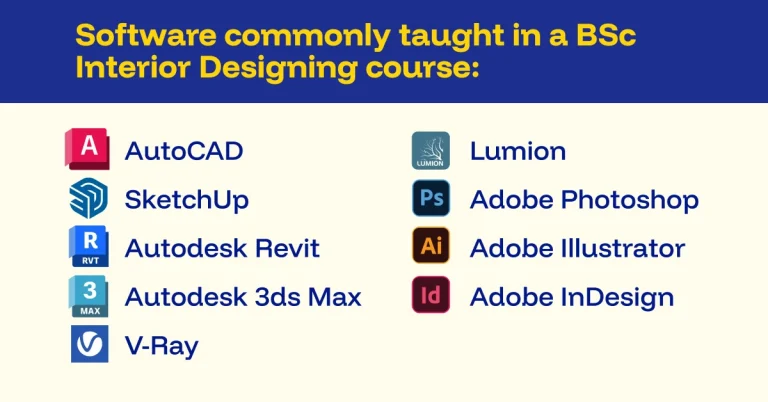
Design, whether interior or fashion, is no more limited to sketches. You have to gain expertise in certain software tools to be industry ready.
You have to learn:
- AutoCAD (Industry tool for creating 2D layouts and 3D visualisations)
- SketchUp (3D modelling tool)
- 3Ds Max (premium industry-standard software tool for 3D space visualisation)
- Revit (a powerful software used for creating intelligent and editable 3D building objects)
- Photoshop (another industry standard designer favourite that helps build realistic visualisation and moodboards)
Design software skills make you more employable.
6. A strong portfolio is more important than marks
A strong portfolio speaks volumes about your expertise, exposure, and experience. Marks take a backseat before the grandeur of your portfolio.
Ideally, your portfolio must include:
- Sketches
- Design concepts
- Moodboards
- 3D designs
- Academic projects
- Internship projects and associated work
Your potential employers will gauge your design acumen through your portfolio, not just your marksheet.
7. Interior Designers work in various industries
Your work is not restricted to home decor.
You can work in:
- Residential units
- Office spaces
- Commercial layouts
- Hotels, cafes, and retail outlets
- Hospitals and research organizations
- Educational institutions
- TV sets and entertainment industries
- Sustainable design consultancies
This industry is ever-expanding with the unforeseen boom in urbanisation and consequent real estate.
👉 Download the Interior Design Course Brochure.
8. Salary varies depending on skills and experience
Of course, one must explore the monetary compensation that entails this job.
The salary offered in India depends on variables like qualification, experience, and location:
- Freshers: INR 2.5 – 4 LPA
- Mid-Level (3-5 years): INR 5 -8 LPA
- Experienced: INR 10 LPA and above
Freelancers and entrepreneurs might earn more based on projects.
9. Communication skills are just as important as Creativity
While creativity is a clear priority in interior designing, communication skills are equally important as you have to:
- Regularly engage with clients
- Explain concepts
- Present and negotiate budgets
- Manage your team
- Coordinate different teams
Even the most competent designs might fail to make an impression if you do not communicate effectively. Soft skills are non-negotiable.
10. Internships make you more employable
You cannot depend on theory alone. Internships give you valuable exposure and make you industry-ready.
It gives you the opportunity to:
- Meet real clients and present your ideas
- Manage expectations
- Solve real-time problems
- Plan budgets and alter them according to emergent issues
- Do site supervision
- Work while managing multiple timelines
Often, designers secure jobs through the network they build during internships.
11. You can start your own firm
Entrepreneurship is common among interior designers. After a few years of industry experience, you can:
- Kickstart your own studio
- Do freelance work
- Do contractual jobs
- Work on personal brand building
If you are fluent in business sense and networking, the right kind of expertise and experience can lead to great growth.
👉 Talk to Our Admission Counselor for Personalised Guidance.
12. Great time in India for Interior Designers
Interior Designing is one of the fastest-growing industries in India. Research reports suggest that it is projected to reach USD 65.01 billion by 2031, and is currently pegged at USD 35.48 billion in 2026.
This is because of:
- Emergent demands for professionally done living spaces
- Rapid urbanisation
- Growing real estate
- Demand for personalised space
- Expansion and modernisation of office and hospital spaces
- Rise in preference for aesthetic lifestyle choices
- Emergent demands for professionally done living spaces
13. Mathematics not as big a problem as you might think
Many of you dread maths. Interior designing needs:
- Basic mathematical understanding
- Scale understanding
- Budgeting calculations
You do not need to know advanced mathematics. Basics can save the day!
14. Drawing skills help- but are not compulsory
Good sketching/drawing skills definitely give you an edge. However, software skills can help, and even compensate. You will get plenty of time during the course when you can commit to learning functional drawing. Practice will only improve your skills. Creativity and conceptual thinking are more significant.
15. Sustainability is the Future of Interior Design
The future in interior designing, like in most other fields, is rooted in sustainability. It is now branching into:
- Eco-friendly products
- Energy-efficient lighting
- Sustainable furniture
- Minimal waste
As sustainability is the way to go forward, students must prepare themselves according to this new world vision. They should understand green principles. This will multiply career opportunities.
16. Work hours can be flexible albeit demanding
Interior Design is not your typical 9-5 job. It involves:
- Site visits
- Multiple revisions based on client feedback
- Tight deadlines
Your work is not limited to only designing and planning. You have to see the project to the very end. However, schedule flexibility and creative satisfaction make it rewarding.
👉 Start Your Interior Design Career Journey Today.
17. This profession calls for patience
Your perception and initial ideation might not be manifested into the final outcome. Not every design will get approved. There might be:
- Multiple revisions
- Client rejections
- Budget changes
- Payment hold-up
Professional maturity is significant. You must have resilience and patience.
18. It is a balance of Arts and Business
A successful interior designer must know how to bring together:
- Creativity
- Budgeting
- People management skills
- Market trends
- Client handling
It is not purely an artistic work area – it is a professional service space.
19. Higher Studies and Specialisation may give you growth
Post-graduate studies, especially niche specialisations, put you ahead of your peers. After graduation, you may go for:
- M.Des in Interior Design
- MBA in Design Management
- Specialised certification courses on sustainable design or lighting.
20. The real requirement is Passion
Probably the most important fact about interior design is that you have to have a burning passion for this work. It is a demanding vocation. You need:
- Continued learning
- Trend knowledge
- Hard work
- Patience
- Passion
This could be a gratifying career option for you as it could be both creative and provide financial stability.
👉 Check Placement & Internship Opportunities after Interior Design Course.
Conclusion
Choosing higher study options might feel intimidating; however, these interior designer facts every 12th pass student must know could help you make an informed decision. Interior designing promises you dynamic professional opportunities with stable financial and creative scope. It places your passion on the forefront.
If you love visualising extraordinary transformations for ordinary spaces, interior design could just be your calling.
Choosing your graduation course can be a paradigm shifting moment for you. Engage with a graduation programme that gives wings to your passion, creativity, and intelligence.
FAQs:-
ANS:- Yes, students from Arts, Science, or Commerce can pursue interior design after 12th. Most colleges do not restrict admission based on stream, but creativity, interest in design, and willingness to learn technical tools are important.
ANS:- Interior design is a balance of creativity and business. Designers must manage budgets, handle clients, follow market trends, and coordinate teams along with creative work.
ANS:- Yes, many interior designers start their own studios, work as freelancers, or take up contractual projects after gaining industry experience.
ANS:- Salary varies based on experience and skills. Freshers can earn around INR 2.5-4 LPA, mid-level professionals earn around INR 5-8 LPA, and experienced designers can earn INR 10 LPA or more.
ANS:- Interior design requires basic mathematics for scale understanding and budgeting, but advanced mathematics is not necessary.