





Choosing a trusted private college in West Bengal after Class 12 is one of the most consequential decisions you will make; it shapes not just your academic journey but your entire career trajectory and professional future.
If you are reading this, you are either a parent or a students are only 17 or 18, navigating this choice with little real-world experience. This guide gives you a clear, practical framework to evaluate any private college and make an informed decision with confidence.
Why Students Are Choosing Private Colleges in West Bengal
The general perception about government colleges in West Bengal is that they are strongly rooted in academics. They have a good reputation for backed government reassurance and subsidized fees. However, despite these facts, we need to focus on 2 aspects. First, not all government colleges have amenities and scope for contemporary educational advancements. Secondly, it is increasingly difficult to get into government colleges because of limited seats. Additionally, in some cases there are competitive exams too. As a result, plenty of students are exploring the sphere of private colleges that offer similar courses along with contemporary facilities.
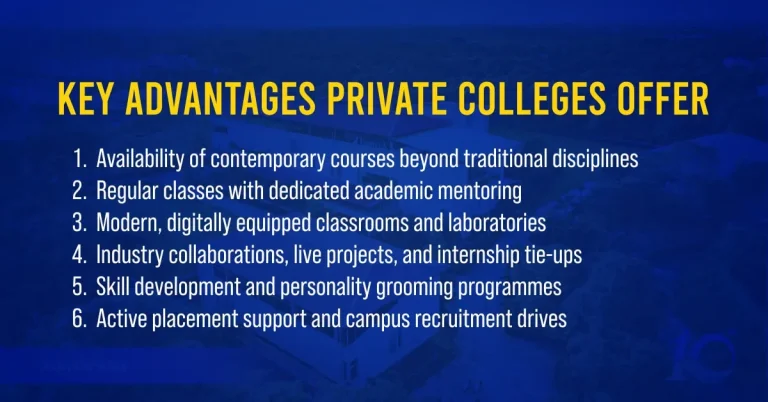
Unlike government colleges, many private colleges aim for the holistic development of the students. They provide academic guidance, along with professional skills and personality grooming, to make students more employable.
👉 Explore industry-focused programs at Inspiria and build skills for tomorrow’s careers.
How to identify a trusted Private College in West Bengal
It is not unheard of that students and parents often fall prey to exaggerated spurious claims of private colleges. It is essential that you evaluate certain important criteria before choosing your college. These criteria will help you gauge the quality of colleges and ensure that you make the right decision.
1. Accreditation, Affiliation, and Approvals
To understand whether the college is authentic and is eligible to disseminate education, you need to check its affiliations. A good college must be recognized by such organizations as:
- University Grants Commission (UGC)
- All India Council for Technical Education (AICTE) (for technical programs)
- National Assessment and Accreditation Council (NAAC)
In West Bengal, if you are opting for a professional, technical, technological, or in some cases, management course, then the college must be affiliated with Malauna Abul Kalam Azad University of Technology (MAKAUT).
Accreditation is necessary to signal that the college adheres to certain standards of academics and maintains quality benchmarks.
👉 Explore how Inspiria’s recognized affiliations and academic standards help students build a strong future.
2. Variety of Courses and Industry Relevance
The courses offered by a college must be aligned with contemporary industry demands.
The job economy is constantly evolving. It is only natural that you go into a course which can situate you in the market with relevant skills. Look for a college that offers in-demand programs as:
- Business Administration
- Computer Applications
- Data Science
- Artificial Intelligence
- Media and Communication
- Journalism and mass communication
- Hospitality Management
- Tourism Management
Choosing a course that is aligned with the industry makes you more employable.
👉 Discover future-ready courses in Management, Technology, Media, Hospitality, and more.
3. Placement Support and Internship Opportunities
You will be committing to a course while investing a lot of time, money, and effort in your college. You should, therefore, scout for a college where there is a functional placement cell. A trusted private college in West Bengal provides all the networking opportunities possible for its students so that they can build a reliable professional career for themselves.
Look out for the following factors:
- A dedicated and functional placement cell
- Internship opportunities along with networking guidance
- Industry training programs and visits
- Campus recruitment
- Career counselling
- Mentorship programs
- Personality development programs to upskill and groom students
A college must support its students’ careers. Placement statistics, starting salary packages, soft skills training to make the students capable candidates, the different companies that visit the campus, etc. are some of the crucial indicators to evaluate the worth of a college.
👉 Discover how Inspiria helps students gain internships, industry exposure, and placement opportunities.
4. Faculty Qualifications and Teaching Quality
More than the infrastructure and structural amenities, you should find out about the teaching faculty of an institute. The quality of instructors immensely influences the quality of academic experience in college.
A trusted private college generally has:
- Highly qualified professors with postgraduate or doctoral degrees in their subject area
- Professors with NET (National Eligibility Test) or SET (State Eligibility Test) qualifications
- Faculty members with research publications and project experience
- Teachers with industry experience for specific departments
- Mentorship programs for students
👉 Learn from experienced faculty and industry experts at Inspiria Knowledge Campus.
5. Infrastructure and Learning Atmosphere
The most important factor that usually distinguishes private colleges from government colleges is the updated, modern infrastructure that they offer. You must make sure that the contemporary infrastructure is not just for marketing gimmicks, but it is there to truly facilitate your education.
Ensure that you check the following points:
- Smart classrooms and digital learning tools
- Library and e-library resources
- Well-equipped laboratories
- Computer labs with updated software
- Libraries with academic resources
- Wi-Fi-enabled campus
Try to enquire about how campus life is. Check if they provide hostel accommodation: on what basis the hostel seats are allotted (merit based or based on distance from hometown). Is there any concession or subsidy with regard to hostel accommodation? Clarity about these important concerns can help you decide a lot of things.
👉 Explore a modern campus environment designed to support learning, innovation, and student growth.
6. Internship and Industry Exposure
In this vastly competitive contemporary job market, practical experience and industry exposure prepare a student for their work life. Any trusted private college in West Bengal should ideally equip the students with plenty of practical experience and exposure.
This should include:
- Internship programs with companies
- Industrial visits
- Workshops conducted by industry experts
- Industry aligned live projects and case studies
When students get opportunities to experience and work out real-world problems, they build professional skills. These also give scope to build valuable networks.
👉 Gain practical experience through internships, workshops, industry visits, and live projects.
7. Personality Grooming and Soft Skills Development
The leap from school to college, and then from college to work-life calls for upskilling and adaptation into completely new roles. While college life might look like an extension of the academic life one is accustomed to in school, things are different at work. A good college tries to provide holistic enrichment to the students with soft skills training.
Beyond the traditional academic knowledge, look out for programs for:
- Communication and public speaking
- Personality development
- Leadership and teamwork
- Entrepreneurship training
These programs teach students leadership qualities, teamwork, communication, problem-solving, and presentation skills. Employers look for these valuable attributes more than just academic acumen.
- Communication and public speaking
- Personality development
- Leadership and teamwork
- Entrepreneurship training
👉 Develop the communication, leadership, and professional skills with Inspiria in house soft skill programs Inskills.
8. Campus Life and Student Life
College life is one of the most memorable phases in a student’s life. A healthy college life comprises not just academics but a conducive environment that contributes to their creative spurt, urge to excel as well as personal growth.
Before choosing a college, find out if the college:
- Hosts cultural events and festivals
- Has student clubs and societies
- Hosts sports activities
- Has community engagement drives
Campus is a space that nurtures a student and lends to their overall growth. The right kind of campus environment can enhance your confidence. Apart from academics, it can direct your co-curricular interests to fruition.
👉 Experience a vibrant campus life that supports academic, personal, and professional growth.
9. Transparent Fee Structure and Scholarships
Even if you study at a private college, the cost of education is an important consideration. It is essential that you compare the fee structure of different institutes for different courses and carefully explore the facilities that they are offering.
You must compare and review the following factors:
- Tuition fees for the entire course
- Hostel and accommodation charges
- Examination and registration fees
- Fees of any additional course that might be offered within the program
- An estimate of the miscellaneous expenses of all the projects that you might be doing
- Miscellaneous fees associated to the hostel accommodation
Do enquire about scholarship schemes that many private colleges offer based on merit, academic performance or financial need. Acquiring a scholarship can be beneficial for you. You must prioritize the college that provides scholarships.
👉 Check out scholarships and financial support options available for eligible students.
10. Alumni Success and College Reputation
A trusted private college in West Bengal is bound to have an illustrious body of alumni. Alumni success stories tell of a college’s education quality. Check out their testimonials to understand the impact of the college on students’ lives.
5 Steps to Choosing the right Private College in West Bengal
A lot of research and planning go into the selection of the right college. You can consult the following steps before making this important academic decision.
Step 1: Identify your career interest
Do your due diligence in finding out what subject/field is best suited for you. Explore all the options that appear appealing to you. Look into the kind of prospects that your chosen course can offer you. Make your mind about the course that excites you and intrigues you.
Step 2: Research colleges extensively
Once you have decided on your field, thoroughly research all the available colleges that offer that course. Go through their official websites, admission brochures, and different educational portals to narrow down the feasible colleges.
Step 3: Compare all the colleges that you have shortlisted
Sit with the shortlisted colleges and compare all the amenities offered by them. Compare all the crucial aspects such as reputation, faculty, fee structure, hostel accommodation, infrastructure, alumni testimonials, placement records, etc.
Step 4: Visit the Campus
Try and visit the campus if possible. Visiting the college campus can give you clarity in a number of aspects. Interacting with the faculty and students could give you valuable insights that might be missing from the generic website or admission websites. You could also do virtual campus tours (if available) to understand the infrastructure offered by the college.
Step 5: Seek Guidance
Despite all the research, nothing can replace human interaction and experience. Do all your research, however, also reach out to your parents, teachers, career counselors, alumni to make a more informed decision.
👉 Need expert guidance? Book a FREE career counseling session today.
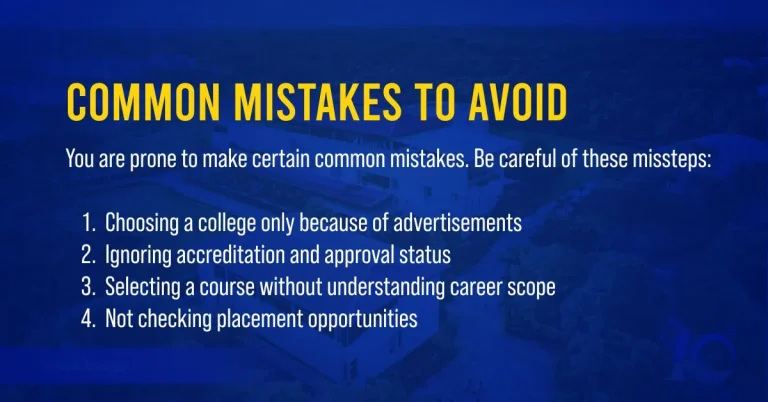
Take ample time to do proper research and weigh your options to avoid making these mistakes.
Final Thought
Selecting your college after Class 12 can be a tough and truly confusing decision. A pro-tip would be to start researching colleges in advance. You should try to at least develop a clear mindset regarding the kind of college you want to get into. Discuss your plans with your parents/guardians and seek their advice as well. A trusted private college in West Bengal should provide you with opportunities beyond academia, while befittingly nurturing your academic interests too. Remember to check:
- The college accreditations and affiliations
- Relevance of your course in the current market economy
- Faculty qualifications and expertise
- Placement opportunities and previous records
- Infrastructure and campus amenities
Thoroughly researching and comparing your available options will help you make an informed decision that aligns best with your career interests and professional prospects.
👉 Ready to begin your journey after Class 12? Apply now and secure your seat for the upcoming academic session.