Are you finding yourself lost in the ocean of sine, cosine, and tangent? Do those trigonometric identities feel like an alien language? Fear not! With a structured approach, a little practice, and some clever techniques for memorization, mastering trigonometry formulas for your class 10, 11, and 12 exams can be easy and fun. This comprehensive guide aims to make these formulas stick with you and equip you with the necessary tools to ace your board exams.
Before diving into formulas, let’s address the elephant in the room: “Why do I need to learn this?” Besides the obvious answer of “to pass your board exams,” trigonometry has practical applications everywhere:
The patterns and relationships in trigonometry appear throughout nature and technology. Mastering these concepts opens doors to understanding how our world works—and yes, it will help you ace those board exams!
Trigonometry is a branch of mathematics that deals with the relationships between the angles and sides of triangles, primarily focusing on right-angled triangles. It helps us understand the world around us in a new light – from engineering and physics to architecture and even computer graphics.
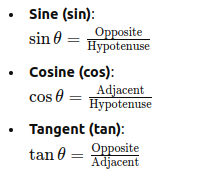
In trigonometry, we work with trigonometric ratios – functions like sine (sin), cosine (cos), and tangent (tan) that are directly related to the sides of a right-angled triangle. Mastery of these formulas is crucial for solving problems on your board exams, and the more efficiently you recall them, the better you will perform.
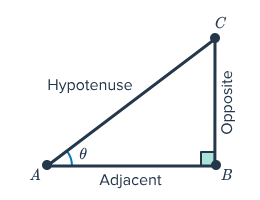
Before diving into complex identities and theorems, let’s ensure we have a solid foundation of all the formulas you’ll encounter. The ratios are based on a right-angled triangle:
The classic mnemonic for the primary ratios:
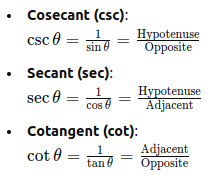
An extended mnemonic for all six ratios: let us call ‘Adjacent’ to be “Base” and ‘Opposite’ to be “Perpendicular” to understand the trick.
Cot = 1/tan = Base / Perpendicular
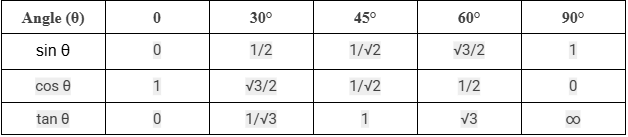
Knowing these values by heart is non-negotiable for board exam success:
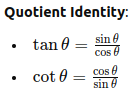
It’s just sine in reverse!
Imagine the fractions as runners in a race:
For any angle θ:
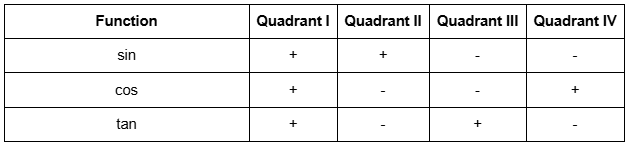
Understanding where functions are positive or negative is crucial:
To remember where functions are positive:
The prefix “co-” in cosine, cotangent, and cosecant is the clue! “Co-” functions are related to complementary angles (angles that add up to 90°).
For angles α and β:
⦁ sin(α + β) = sin α cos β + cos α sin β
⦁ sin(α – β) = sin α cos β – cos α sin β
⦁ cos(α + β) = cos α cos β – sin α sin β
⦁ cos(α – β) = cos α cos β + sin α sin β
⦁ tan(α + β) = (tan α + tan β)/(1 – tan α tan β)
⦁ tan(α – β) = (tan α – tan β)/(1 + tan α tan β)
For sin(α + β):
⦁ Sine of first × coSine of second
⦁ plus
⦁ cosIne of first × sIne of second
For cos(α + β), it’s the same pattern but with a minus instead of plus.
Notice how sin and cos sum/difference formulas follow a pattern:
⦁ In sin formulas, the middle sign matches the operation (+ for addition, – for subtraction)
⦁ In cos formulas, the middle sign is opposite to the operation (- for addition, + for subtraction)
⦁ sin 2θ = 2 sin θ cos θ
⦁ cos 2θ = cos²θ – sin²θ = 2cos²θ – 1 = 1 – 2sin²θ
⦁ tan 2θ = 2tan θ/(1 – tan²θ)
For sin 2θ, imagine double high-fiving:
⦁ “Two hands slap together” = 2 sin θ cos θ
For cos 2θ, you have three options (pick your favorite):
⦁ “Cosine squared minus sine squared”
⦁ “Twice cosine squared minus one”
⦁ “One minus twice sine squared”
⦁ sin 3θ = 3sin θ – 4sin³θ
⦁ cos 3θ = 4cos³θ – 3cos θ
Notice both formulas involve 3 and 4:
⦁ Sin: 3 times first degree minus 4 times third degree
⦁ Cos: 4 times third degree minus 3 times first degree
⦁ Notice the pattern: 3 and 4 appear in both but in opposite orders!
⦁ sin(θ/2) = ±√[(1 – cos θ)/2]
⦁ cos(θ/2) = ±√[(1 + cos θ)/2]
⦁ tan(θ/2) = (1 – cos θ)/sin θ = sin θ/(1 + cos θ)
Think of the half-angle formulas as finding half of something under a square root:
⦁ Sin half-angle: “One minus cosine, divided by two, all under a radical”
⦁ Cos half-angle: “One plus cosine, divided by two, all under a radical”
⦁ sin α sin β = ½[cos(α – β) – cos(α + β)]
⦁ cos α cos β = ½[cos(α – β) + cos(α + β)]
⦁ sin α cos β = ½[sin(α + β) + sin(α – β)]
⦁ Same functions (sin×sin or cos×cos) give cosine results
⦁ Different functions (sin×cos) give sine results
⦁ For sin×sin: minus sign between terms
⦁ For cos×cos: plus sign between terms
⦁ For sin×cos: always plus sign between terms
“When same meets same, cosine comes out, When different functions come about, Sine is what it’s all about. Sin-sin takes minus in the middle, Cos-cos takes plus without a riddle, Sin-cos takes plus as clear as a fiddle!”
⦁ sin α + sin β = 2 sin[(α + β)/2] cos[(α – β)/2]
⦁ sin α – sin β = 2 cos[(α + β)/2] sin[(α – β)/2]
⦁ cos α + cos β = 2 cos[(α + β)/2] cos[(α – β)/2]
⦁ cos α – cos β = -2 sin[(α + β)/2] sin[(α – β)/2]
⦁ Sin plus Sin: Start with Sin, follow with Cos
⦁ Sin minus Sin: Start with Cos, follow with Sin
⦁ Cos plus Cos: Double Cos (both terms are cosine)
⦁ Cos minus Cos: Double Sin with negative sign
“Sine plus sine: sine-cosine in a line, Sine minus sine: cosine-sine works fine, Cosine plus cosine: cosine twice will shine, Cosine minus cosine: sine twice with a negative sign.”
“Sine and cosine come full circle after 2π, Tangent only needs π to begin anew!”
⦁ sin(π – θ) = sin θ
⦁ cos(π – θ) = -cos θ
⦁ tan(π – θ) = -tan θ
“When angles add to make a straight line (π), Sine stays the same, feeling fine, But cosine and tangent change their sign!”
Create logical connections between formulas:
⦁ Double angle formulas are derived from sum formulas (when α = β)
⦁ Half-angle formulas come from double-angle formulas (substitute 2θ = α)
⦁ Triple-angle formulas combine double-angle and sum formulas
Visualize all formulas as members of a family:
⦁ Pythagorean identities are the grandparents
⦁ Sum and difference formulas are the parents
⦁ Double and half-angle formulas are the children
⦁ Triple angle formulas are the cousins
⦁ Product-to-sum and sum-to-product are the siblings
Create vivid mental images:
⦁ For sin²θ + cos²θ = 1: Picture a right triangle inside a unit circle
⦁ For double angle formulas: Imagine an angle doubling in size
⦁ For quadrant rules: Visualize a compass with signs marked in each direction
Instead of pure memorization, learn to derive formulas:
⦁ Start with the sum formulas and derive double angle formulas (set α = β)
⦁ Use Pythagorean identities to transform expressions
⦁ Practice deriving one formula from another until it becomes second nature
If unsure about a formula during the exam:
⦁ Substitute special values (0°, 30°, 45°, 90°)
⦁ Verify both sides of the equation match
⦁ This works especially well for identities you’re unsure about
“When in doubt, check it out, With 0, 30, 45, and 90 all about. If both sides match without a doubt, Your formula is correct, no need to pout!”
⦁ Sign errors: Especially in quadrants II, III, and IV
⦁ Formula confusion: Double-checking which identity to apply
⦁ Degree/radian mix-ups: Being consistent with your angle measures
⦁ Algebraic slips: Taking care with simplifications
⦁ Signs (be careful with negative signs)
⦁ Angle measures (be consistent with degrees/radians)
⦁ Formulas (double-check which one applies)
⦁ Equation solving (watch your algebra steps)
⦁ Quick verification- Use special angles (0°, 30°, 45°) to check if your formula is correct
⦁ Draw unit circles- Helps visualize relationships
⦁ Write down formulas first- Before starting the problem
⦁ Cross-check answers- Substitute back to verify
Verify with special angles, Draw unit circles, Create formula sheets, Substitute back
Don’t try to memorize everything at once! Follow this schedule:
⦁ Day 1: Basic ratios and standard angles
⦁ Day 2: Review Day 1 + Pythagorean identities
⦁ Day 3: Review Day 2 briefly + Sum/difference formulas
⦁ Day 4: Review Day 3 briefly + Double angle formulas
⦁ Day 7: Review everything briefly + Product to sum formulas
⦁ Day 10: Comprehensive review
⦁ Day 15: Another comprehensive review
Trigonometry isn’t just about passing exams—it’s a powerful mathematical tool that reveals our universe’s elegant patterns. By mastering these formulas through systematic memory techniques, you’re not just memorizing meaningless symbols; you’re gaining access to a language that describes circles, waves, oscillations, and cycles—phenomena that appear everywhere from music to physics, architecture to biology.
The brain loves patterns, stories, and connections. Using the memory aids in this guide, you’re working with your brain’s natural strengths rather than against them. Whether you prefer visual associations, silly stories, or rhythmic mnemonics, find what works for you and stick with it.
If you found this guide helpful, share it with your classmates and drop your questions in the comments below! Need a trigonometry formula cheat sheet? Download it from below!
For any assistance or help regarding counselling please feel free to contact us anytime at +91-8900755550. We will be more than happy to assist you.
2 Responses
Thank You for the information, Really liked the blog !
Thanks for the pdf, it was really helpful