




In the past, Computer Science Engineering (CSE) was the undisputed king of tech degrees. However, the landscape shifted in 2024 when the All India Council for Technical Education (AICTE) brought BCA and BBA under its wing. Today, an AICTE-approved BCA is no longer just a “second option”- it’s a streamlined, industry-aligned alternative to the 4-year BTech.
In this blog, we shall explain why the AICTE approved BCA program is at par with Computer Science Engineering in terms of the curriculum structure, industry relevance and employability factor and can be a better course option for students for good reasons. This blog explores why the current AICTE-approved BCA course may be a better choice than Computer Science Engineering in terms of curriculum, skills, industry relevance, and career opportunities
AICTE Affiliation to the BCA Program
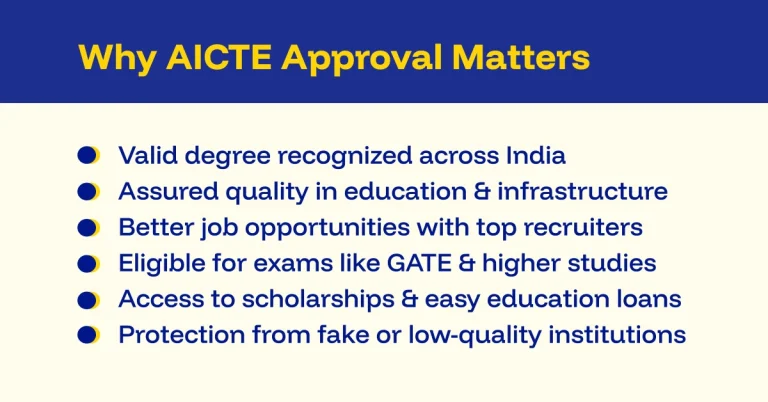
The All India Council for Technical Education (AICTE) announced in 2024 that from the 2024-25 academic session, all BCA programs in the country would have to meet its approval. Mere university affiliation would not suffice for BCA (as well as BBA).
AICTE also laid down guidelines for the BCA syllabus structure, which would have to be followed by institutes teaching the BCA course. AICTE’s objective in laying down these conditions was to ensure uniformity and quality of the course through a model curriculum that would incorporate topics like emerging technologies and Artificial Intelligence (AI) in the syllabus.
👉 Confused between BCA and Computer Science Engineering? Explore industry-focused BCA programs designed for modern tech careers.
About Bachelor of Computer Applications (BCA)
The BCA course equips students with the fundamental skills in software development, programming and web designing, preparing them for highly prospective career positions in the IT sector.
The main benefits of studying a BCA are:
- BCA is open to students from diverse backgrounds and can also be pursued without a Maths background.
- As per NEP guidelines, BCA students can opt to exit with a BCA degree after 3 years. This allows a quicker entry into the job market.
- BCA is an affordable course compared to other tech/engineering degrees.
- BCA graduates can take on career roles such as web designers, software developers, database administrators, technical analysts and system administrators.
Following the implementation of AICTE approved curriculum with upgraded course content, BCA today is often perceived as a better choice than B.E. or B.Tech in Computer Science Engineering as we shall discuss below.
About Computer Science Engineering
Computer Science Engineering (CSE), with denomination of B.E. or B.Tech, is a 4-year UG engineering degree course that integrates engineering and computer science. It teaches students how to design and develop software driven technology systems. The course includes Algorithms, AI, Programming and Cybersecurity. CSE students have the potential to achieve highly lucrative jobs in the field of data analysis, software development and Information Technology (IT).
The core subjects taught in CSE include Programming Languages (C++, Java, Python), Computer Networks, Operating Systems, Databases (SQL), Data Structures and Algorithms, and Artificial Intelligence (AI). Moreover, students also gain knowledge and skills in critical emerging technologies such as Machine Learning (ML), Big data, Blockchain and Internet of Things (IoT).
CSE graduates can assume career roles such as Data Scientist, Software Engineer, AI Engineer, Cybersecurity Specialist and AI Engineer. A highly sought after course, students must have a science background at the class 12 level with Mathematics and Physics and also have to clear highly competitive entrance exams like JEE Mains to gain admission.
BCA Vs Computer Science – Course Overview
The following table provides a comparison between the broad course features of BCA and Computer Science Engineering (CSE):-
| Course Feature | BCA | CSE |
| Nature of Degree | Professional UG Course on Computer Applications | Engineering UG degree in Computer Science |
| Duration of Course | 4 years (as per NEP) with 3 year exit option | 4 years |
| Approving Body | AICTE Approved | AICTE Approved and Regulated |
| Core Course Content | Software Development + Emerging technologies (AI, ML) | Computer Science + Software + Ml +Ai |
| Admission Criteria | 10+2 from diverse backgrounds | 10+2 with Physics, Chemistry, and Mathematics |
👉 Want to understand what you’ll actually learn in a BCA program? Explore the detailed curriculum covering programming, AI, and industry-relevant tech skills.
BCA Vs Computer Science – Curriculum Comparison
As stated, after AICTE approval was made compulsory in 2024, the BCA curriculum became more structured and tech-oriented, and aligns with current day industry benchmarks. For all practical purposes, the current AICTE approved BCA curriculum has little difference with the curriculum of Computer Science table as can be understood by the following comparison table.
| Academic Topics | BCA | CSE |
| Programming Languages | C, C++, Java, Python | C, C++, Java, Python |
| Data Structures | Yes | Yes |
| Database Management Systems | Yes | Yes |
| Software Engineering | Yes | Yes |
| Operating Systems | Yes | Yes |
| Computer Networks | Yes | Yes |
| Artificial Intelligence | Included from 2024-25 | Included |
BCA Vs Computer Science – Career Scope
The following table states the career scope of both BCA and CSE graduates:-
| Job Role | BCA Graduates | CSE Graduates |
| Software Developer | Eligible | Eligible |
| Web Developer | Eligible | Limited eligibility |
| Data Analyst | Eligible | Eligible |
| Cybersecurity Specialist | Eligible | Eligible |
| System Administrator | Eligible | Eligible |
| Hardware Engineer | Limited eligibility | Eligible |
Final Word – Why is the Current BCA Program Better than CS Engineering?
Thus, we can see that there is no significant difference between the BCA program and CSE Engineering. In fact the BCA option is often considered better for the following reasons:-
- BCA is a more affordable option. Admission to CSE involves rigorous entrance exams which are difficult to crack. Course fees for B.Tech or B.E. in CSE are significantly higher. In contrast, gaining admission to a reasonably good college is far more practical and feasible.
- Despite the different nomenclature, the two courses today are 90% similar in terms ofcontent. Students thus find BCA more prospective as it does away with the need to crack difficult entrance exams and pay high fees for the CSE course when you can learn the same things doing BCA.
- BCA program is more suitable for those aiming for a career in software development due to its practical, skill focussed approach.
- BCA program is more flexible as it allows the option of exiting after three years with the degree. This suits students who are keen to enter the industry early due to family or other compulsions.
- The integration of emerging technologies such as Machine Learning (ML), Artificial Intelligence (AI) and Internet of Things (IoT) have made the BCA course aligned with the latest in technological/industry benchmarks.
This is the reason why more and more students are preferring BCA to CSE and the growing recognition of BCA as a professional computing degree.
👉 Ready to start your tech career after 12th? Apply for an industry-focused BCA program and take the first step toward your future.
FAQs:-
ANS:- An AICTE-approved BCA has become largely comparable to Computer Science Engineering in terms of curriculum and industry relevance. After the 2024 reforms, BCA programs now include advanced subjects like Artificial Intelligence, Machine Learning, and software development. While CSE still focuses more on hardware and engineering aspects, the difference in core computing skills is now minimal.
ANS:- AICTE made approval mandatory to ensure uniform quality and standardization across all BCA programs in India. The goal was to align the curriculum with current industry requirements, including emerging technologies. This move also helps students gain better recognition and credibility for their degree.
ANS:- Yes, one of the major advantages of BCA is that students from diverse academic backgrounds can apply. Many colleges allow admission without Mathematics at the 12th level. This flexibility makes BCA accessible to a wider range of students interested in IT careers.
ANS:- Yes, BCA is generally more affordable compared to a B.Tech or B.E. in Computer Science Engineering. Engineering programs often involve higher tuition fees and additional entrance exam preparation costs. BCA provides a cost-effective pathway to enter the tech industry with similar skill development.
ANS:- After AICTE approval, the BCA curriculum has become more structured and industry-oriented. Both BCA and CSE now cover similar subjects like programming, databases, operating systems, and AI. The main difference lies in CSE having deeper coverage of hardware and engineering concepts.
ANS:- Yes, BCA graduates are eligible for many of the same job roles as CSE graduates, especially in software and IT domains. Roles like software developer, data analyst, and cybersecurity specialist are open to both. However, hardware-specific roles may still favor CSE graduates.
ANS:- Under NEP guidelines, BCA is structured as a four-year program with a flexible exit option after three years. This allows students to earn a degree and enter the workforce earlier if needed. The flexibility makes BCA suitable for students with different career plans.
ANS:- AICTE approval ensures that the BCA curriculum follows a standardized and updated framework. It includes modern technologies, practical training, and industry-relevant subjects. This improves both the quality of education and the employability of graduates.
ANS:- Computer Science Engineering (CSE), with denomination of B.E. or B.Tech, is a 4-year UG engineering degree course that integrates engineering and computer science. It teaches students how to design and develop software driven technology systems. The only difference between CSE and BCA is the focus on engineering and hardware technology in CSE. However following recent restructuring of BCA syllabus with addition of latest emergent technologies, the difference in course content between the two courses today is minimal.