Have you noticed the sudden shift towards animated AI and non-AI short-form content on Instagram and YouTube? In fact, animated videos are widely used for educational purposes, explaining complex topics in simpler, more fun ways.
Not only that, but the gaming industry has become a major driver of demand for animation. Popular video games like Fortnite and Call of Duty rely heavily on high-quality animation for immersive experiences, character design, and realistic environments.
The demand for animation is growing at an unprecedented rate. So, how does the future of animation look in India? Let’s learn more about the scope of animation in India, emerging trends, and career opportunities waiting ahead.
What is Animation?
Animation is the process of giving life to drawings and making those images look like they are moving. Instead of real movements, it’s created by showing a series of pictures very quickly, each slightly different from the last. It’s more like a flipbook; when you flip the pages fast, the drawings seem to come alive.
Earlier pictures were drawn or painted on transparent celluloid sheets to be photographed. Early cartoons are examples of this, but today, most animated movies are made with computer-generated imagery or CGI.
Today, animation is used in movies, cartoons, games, ads, and even apps to tell stories and explain ideas in a fun, visual way.
👉 Interested in building a creative career in animation? Explore professional animation courses after 12th.
Scope of Animation in India (2026 & Beyond)
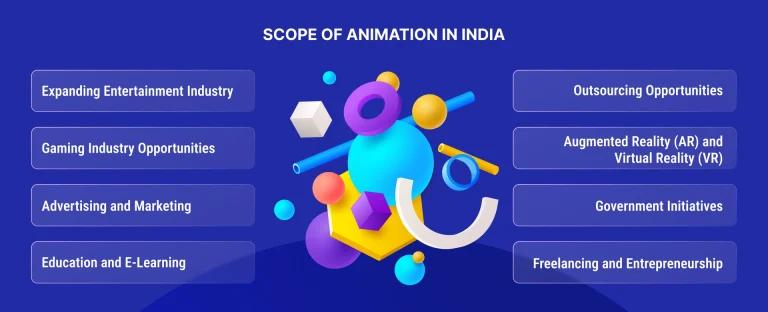
The animation industry in India is growing fast and is becoming one of the most promising creative career sectors. With digital content, gaming, OTT platforms, and advertising expanding rapidly, the demand for skilled animation professionals is increasing year after year.
Key Points & Facts:
- Fast-growing industry:
India’s AVGC sector is expanding rapidly due to increasing demand for digital content across entertainment, education, and marketing. Industry reports estimate the sector could reach $2–3 billion by 2026, driven by OTT platforms, gaming, and global outsourcing.
What is the reason for growth?
- Rise in internet users and smartphones
- Increased demand for animated and VFX-heavy content
- India is becoming a global outsourcing hub
2. Job creation
The AVGC sector is highly labour-intensive and skill-driven. As studios expand, hundreds of thousands of jobs are expected in roles like animation, game design, and VFX.
Types of jobs created:
- Creative roles (animators, designers)
- Technical roles (rendering, pipeline engineers)
- Production & management roles
3. OTT boom:
Streaming platforms like Netflix, Amazon Prime Video, and Disney+ are investing heavily in animated shows, VFX-heavy films, and regional content.
Impact:
- Global exposure for Indian studios
- More demand for high-quality animation
- Increased production of original content
Wide industry use:
Animation is no longer limited to cartoons; it’s used across multiple platforms
- Films & Web Series
- Advertising & Marketing
- Education ( e-learning content)
- Mobile apps & UI design
- Gaming
- Social Media Content
For example, animated explainer videos are widely used in startups and EdTech platforms
Global opportunities:
Indian professionals are in demand worldwide because:
- High-quality work at competitive costs
- Strong technical and creative skills
- English proficiency and global collaboration
Many international studios outsource projects to India.
Government support:
The Indian government is actively promoting AVGC through policies and initiatives to make India a global content hub.
Key initiatives:
- AVGC Promotion Task Force
- Skill development programs
- Incentives for studios and startups
Diverse career roles:
The AVGC field offers a wide range of career paths:
- 2D/3D Animator
- VFX Artist
- Motion Graphics Designer
- Game Designer
- AR/VR Developer
Each role blends creativity with technical skills.
Tech-driven future:
Modern animation is deeply integrated with technology:
- AI tools for animation automation
- Real-time rendering (used in gaming & films)
- AR/VR for immersive experiences
This makes AVGC one of the most future-proof creative industries.
The AVGC sector in India is not just growing, it’s transforming into a global creative-tech powerhouse. With strong government backing, rising OTT demand, and global outsourcing opportunities, it offers high growth, diverse careers, and international exposure.
👉 Want to learn how animation works in real projects? Discover industry-focused animation training programs.
Career Opportunities in Animation in India
Animation Salary in India
The average animation designer salary in India depends on experience, specialzation, portfolio quality, and the company.
- Entry-level animators: Rs 2.5 - 4.5 LPA
- Mid-level animators: Rs 5 - 10 LPA
- Senior animators: Rs 12 - 25 LPA
- Creative directors and animation heads: Rs 30 - 40 LPA
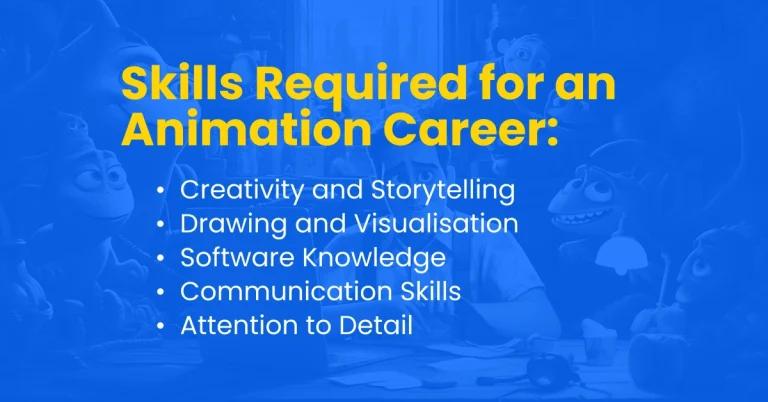
Skills Required for Animation Career
- Creativity and Storytelling:- Animation is about conveying a story in an enaging manner, and for that you need imagination to create characters, worlds, and narratives that connect with the audience emotionally. Strong storytelling helps in making scenes meaningful and impactful.
- Drawing and Visualization:- The ability to sketch ideas and visualize scenes is crucial, especially in roles like storyboard artist and character designer. Even in 3D animatio, understanding shapes, anatomy, and perspective is important
- Software Knowledge:- Animators must be familiar with industry tools such as Autodesk Maya, Blender, Adobe After Effects, and Toon Boom Harmony to create, edit, and render animations efficiently.
- Communication Skills:-Animation is a team effort, that is why communication is an absolute key. Artist must communicate ideas clearly with directors, designers, and other team members to ensure the final output matches the vision.
- Attention to Detail :- Small details like timing, movement, lighting, and consistency can make a huge difference in animation quality. Precision ensures smooth motion and professional results.
👉 Confused about which role suits you? Get expert guidance and choose the right animation career path.
Step-by-Step Guide for a Career in Animation
Step 1: Choice
The first step is to choose your specialization beginning with the understanding of different areas within animation and deciding what interests you the most. Fields like 2D animation, 3D animation, VFX, game design, and motion graphics all require slightly different skills. If you enjoy drawing and storytelling, you might lean toward 2D animation or character design. If you are most interested in technology and realistic visuals, then 3D animation or VFX could be the right choice.
Step 2: Join an Animation Course
After choosing your specialization, enroll in a course that helps you build the required skills. This could be a degree program or a diploma/certificate course. Focus on institutes that offer practical training, industry exposure, and opportunities to work on real projects rather than just theory.
Step 3: Learn Industry Software
Animation is highly skill-based, so learning the right tools is essential. Start with basic software and gradually improve your skills. Tools like Autodesk Maya, Blender, Adobe After Effects, and Toon Boom Harmony are widely used. It’s better to master one tool first instead of trying to learn many at once.
Step 4: Build a Strong Portfolio
As you learn, start creating your own projects and collect your best work in a portfolio. This can include animations, character designs, storyboards, or 3D models. Your portfolio is what employers will look at, so focus on quality rather than quantity.
Step 5: Apply for Internships
Once you have some basic skills and a portfolio, start applying for internships or entry-level roles. This will help you gain real-world experience, understand how projects are handled, and improve your skills further. Many students get their first full-time job through internships.
👉 Want to start your animation career without entrance exams? Apply now for direct admission and secure your seat today.
Conclusion
The animation industry in India is growing at a fast pace, driven by digital patform, gaming, films, and increasing global demand. With continuous advancements in technology and strong industry support, this field is creating a wide range of opportunities for skilled professionals.
From entertainment to education and advertising, animation is now an essential part of many industries. And, this is a great time for students to consider animation as a career because of the rising opportunity.
With technologies like AI, real-time rendering, and immersive media shaping the future, the demand for talented animators is only expected to increase. With the right skills and dedication, animation can offer both creative satisfaction and stong career growth.