



You have completed your class 12 with commerce subjects, but you have a knack for creativity to transform spaces into aesthetic and effective layouts. This is not as paradoxical as you might think. Commerce stream students do not have to go for only management or accountancy-based career options. If you are enthusiastic about transforming spaces into beautiful, effective, and accessible places, interior design might just be the best course for you after 12th boards. However, the most common confusion that you could face is the choice between B.Des and B.Sc Interior Design.
Both are unique design courses with curriculum tailored to produce skilled interior designers. There are differences in approach, curriculum design, career scope, and primary focus area. You must understand all the differences and the scope that each course offers so that you can make an informed choice based on what aligns with your career objectives the best. In this guide, we discuss all the aspects related to the interior design course after class 12th Commerce so that you can choose between B.Des and B.Sc Interior Design.
Interior Design After 12th Commerce: Why?
The general perception about designing courses is that they are for students with Humanities affiliations. This is obviously not true. Interior Design, for example, is an undergraduate course that you can pursue without giving thought to any such preamble. It is a skill-based professional course, and commerce students can easily master it.
Interior Design is an exciting option for you because:
- Increasing demand in real estate and urban development in the contemporary market
- It is a process that streamlines creativity to practical accomplishment
- Opportunities in residential, commercial, and retail sectors. There is scope for higher education, too.
- Beyond routine job set-up there is scope for freelancing and entrepreneurship too
B.Des in Interior Design
B.Des or Bachelor of Design is a professional design degree that focuses on creativity, innovation, and user-centric design.
Features:
- Focus is on design thinking and creativity
- Project-based learning more than theoretical academic studies
- Learning industry tools and trends
- Portfolio development and progress
Subjects included:
- Design fundamentals
- Spatial planning
- Furniture design
- Visual Communication
- Computer-Aided Design (CAD)
- Design Theory
Overall, this is an ideal course for you if you aim to become a creative designer with strong conceptual grounding.
B.Sc in Interior Design
B.Sc Interior Design or Bachelor of Science in Interior Design is a structured undergraduate course that is technical and application oriented.
Features:
- Primary focus is on practical and technical knowledge
- It is a structured and theory-based course
- Covers lessons in construction, materials to execution
Subjects included:
- Interior construction
- Material studies
- Building services
- Environmental design
- Drafting and detailing
You can opt for B.Sc Interior Design if you are more enthusiastic about the execution, planning, and technical aspects of design.
👉 Looking for a practical and technical approach to interior design? Explore B.Sc Interior Design programs with hands-on training.
Key Differences Between B.Des and B.Sc Interior Design
| ASPECT | B.Des Interior Design | B.Sc Interior Design |
| Approach | Creative and conceptual | Technical and practical |
| Focal Area | Design thinking | Structured and executive |
| Learning Style | Project-based | Theoretical and practical |
| Skills | Creativity, innovation | Technical, planning |
| Career Trajectory | Designer, creative fields | Technical designing, planning |
B.Des VS B.Sc Interior Design: Which one is better?
There is no unambiguous answer to this riddle. You need to work this out bearing in mind your interests and career objectives.
Go for B.Des if:
- You are enthusiastic about creativity and the creative field
- You like and enjoy sketching, ideation, and innovation
- You aim to work for design firms
- You see yourself as good with branding, styling, or conceptual design work
Go for B.Sc if:
- You would like to do structured learning with technical details
- You are interested in construction and materials
- You aim for technical roles
- You focus on details and practical work
Career Opportunities Offered by Interior Design
There are plenty of job roles that both these degrees offer.
Career trajectory after B.Des:
- Interior Designer: An Interior Designer works to create functional and aesthetically appealing spaces for commercial establishments, residential spaces, office spaces, etc. They focus on building brand identity, customer experience, device creative designs, personalized spaces, catering to customer demands and adhering to public safety regulations in these places.
- Furniture Designer: They are exclusively specialized in designing functional, innovative, and ergonomic furniture, managing client expectations and the trends of the time. They might work independently or with companies to develop products and designs.
- Set Designer for Films, TV, or OTT: They design and build sets for the entertainment industry that are best suited for the script’s settings, scope, and mood. The set designers work with directors and art teams to create the most effective sets.
- Visual Merchandizer: They design stores in a way that influence and style branding by focusing on product placement, lighting, colors, and themes. They make the stores look attractive so that customers are encouraged to purchase that brand’s products.
- Design Consultant: They work with clients to understand their needs and vision and accordingly suggest suitable design solutions in their budget. Their focal area is concept development, aesthetics, and functionality. They guide clients with the right design style, materials, and layouts.
Career trajectory after B.Sc:
- Interior Planner: They work to make spaces functional, accessible, and comfortable. They ensure effective utilization of spaces by laying out designs and doing space organization. Their work spans furniture placement, determining usability, and visualizing circulation area.
- Site Supervisor: A more technical job role; a site supervisor manages on-site activities more related to the execution of design projects. They manage work and pay attention to time constraints, budget adherence, and design execution. Their responsibility is overseeing and ensuring smooth implementation of the project.
- CAD Designer: They transform designs into digital models. They use software tools to create 2D and 3D models. Engineers, architects, and contractors use these designs for project integration and execution.
- Project Planner: They help co-ordinate and plan the design projects. They plan the workflow, scheduling, communication, documentation, and coordination between teams and ensure a smooth organization.
- Space Planner: They design places so that they are safe, accessible, functional, and aesthetic. They consider client expectations and produce design layouts that are conducive to movement and usability.
👉 Need expert guidance to choose between B.Des and B.Sc? Get free counselling and make the right career choice.
Salary Comparison:
Salary in a career in interior design often depends on location, experience, reputation, and Skills, rather than the degree.
Average Salary in India
- Fresher: Rs. 2.5- Rs. 4.5 LPA
- Mid-level (3-5 years): Rs. 6- Rs. 10 LPA
- Senior Designers: Rs. 12- Rs. 20+ LPA
Freelancers and Studio Owners
- Earnings are mostly project-based.
- Ability and opportunity to earn Rs. 50,000 to several lakhs per project.
- Their growth in income is often proportional to their growth in network and portfolio.
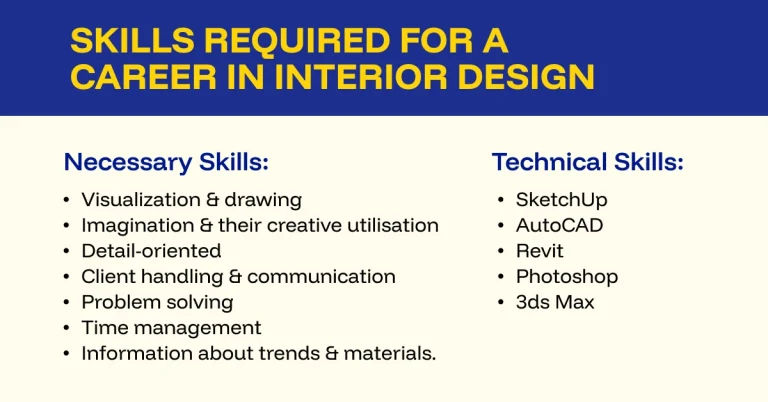
What are the skills required for a Career in Interior Design?
In order to succeed in a career in interior design, one would need to mix their technical skills with their creative side.
Necessary Skills:
- Visualization and drawing
- Imagination and their creative utilisation
- Detail-oriented
- Client handling and communication
- Problem solving
- Time management
- Information about trends and materials.
Technical Skills:
- SketchUp
- AutoCAD
- Revit
- Photoshop
- 3ds Max
It is important to note that soft skills are quite essential since designers would be interacting constantly with contractors, clients, and vendors.
👉 Explore career opportunities in interior design across residential, commercial, and creative industries.
What are the Interior Design Courses available apart from B.Des and B.Sc?
Diploma Courses in Interior Design:
This course is offered for a duration of 1-2 years and is ideal for those students who expect a quicker entry into this industry. The features of this degree are:
- Affordable
- Skill- oriented
- Job focused
- Practical training
Diploma holders usually gain employment as design assistants, junior designers or site coordinators.
Certificate Courses:
Certificate courses are offered for a duration of 3-12 months. These courses are best suited for:
- Beginners expressing their interest in the profession.
- Professionals who are gainfully employed in other industries.
- Students who want specific skills, such as SketchUp or AutoCad etc.
For a long-term career growth perspective, a proper, full-time (B.Des or B.Sc) is a feasible and more recommended career path.
Are There Entrance Exams?
There are a few reputed institutions that conduct entrance tests in order to assess the aptitude and creativity of the students.
Common Entrance Exams:
- NID DAT
- NIFT Entrance Exam
- CEED
- Aptitude tests which are institute specific.
These exams are designed to test the:
- Visual imagination
- Logical reasoning
- Drawing skills
- Design sensitivity
👉 Explore industry-focused interior design programs with practical training and real-world projects.
B.Des or B.Sc Interior Design Final Verdict
After accumulating and absorbing all this information, your choice should be based on:
- Opting for B.Sc if you want to earn technical expertise and structured learning outcomes
- Opting for B.Des if you wish for creative freedom and innovation
The final choice should not be about assessing which course is better; it is about assessing which one is the best-suited course for you. Interior design is an exciting career choice for commerce students, offering novelty in comparison to traditional options. In addition, you can even retain and utilise what you have learnt so far in your high school. It does incorporate and integrate mathematics, accounting, planning, and management.
The choice between B.Des and B.Sc depends on your calling and subjective preference. Ask yourself if you are more inclined towards design concepts or their execution. Would you rather indulge in creativity or technical work? Your answer would lead you towards the best path for you.
FAQs:-
ANS:- Yes, students from a commerce background can pursue both B.Des and B.Sc Interior Design after 12th, as most colleges accept all streams.
ANS:- Both courses are good, but it depends on your career goals. B.Des focuses more on creativity and design, while B.Sc Interior Design focuses on technical and practical knowledge.
ANS:-The main difference is that B.Des is design-oriented and focuses on creativity, while B.Sc Interior Design is more technical and includes practical and scientific aspects of interior design.
ANS:- Both B.Des and B.Sc Interior Design courses typically have a duration of 3 to 4 years, depending on the university.
ANS:- Both courses can lead to a career in interior design. However, B.Des is preferred for creative roles, while B.Sc Interior Design is ideal for technical and execution roles.