




Think of life as a constant stream of decisions; you choose which route to take to school, to avoid traffic, what study plan to follow for exams, or even which snacks to buy within your budget. Data Science is just like that, but on a larger scale. It’s about noticing patterns, making sense of information, and using it to make better choices.
In this blog, we will cover Data Science Colleges in West Bengal and give a comparison between private and government colleges.
What Are Government Data Science Colleges in West Bengal?
Government Data Science colleges are institutions funded and regulated by the state or central government. They usually offer Data Science as part of broader programs like B.Sc, B.Tech, or M.Sc with a specialisation in Data Science or related fields.
Admission Process in Government Data Science Colleges
Admissions are typically entrance-based, such as:
- State-level or national-level entrance exams
- Merit-based shortlisting with high cut-offs
- Centralised counselling processes
Fee Structure in Government Data Science Colleges
The fee structure in government Data Science colleges is low and affordable, generally ranging between Rs 10,000 and Rs 25,000 for the entire course of 3-4 years.
Pros & Cons of Government Data Science Colleges
Pros
- Very affordable fees
- Strong academic reputation
- Experienced faculty
Cons
- Limited seats and high competition
- Slower curriculum updates
- Less focus on practical skills and placements
👉 Check eligibility requirements for Data Science courses
What Are Private Data Science Colleges in West Bengal?
Private Data Science colleges are run by educational trusts or organisations and are designed to meet current industry needs. Many offer specialised programs like BCA or B.Tech in Data Science, AI & ML.
Admission Process in Private Data Science Colleges
The admission process is usually more student-friendly, including:
- Merit-based admission
- Institution-level entrance tests
- Personal interviews or counselling
Seats are more accessible compared to government colleges.
Fee Structure in Private Data Science Colleges
Private colleges have higher fees, generally ranging from ₹1.5 to ₹4 lakhs per year. However, this often includes labs, certifications, internships, and placement training.
Pros & Cons of Private Data Science Colleges
Pros
- Industry-aligned curriculum
- Hands-on projects and internships
- Better placement and skill development support
Cons
- Higher fees
- Quality varies between institutions
👉 Explore the Data Science curriculum with practical training
Private vs Government Data Science Colleges in West Bengal
| Factor | Government Colleges | Private Colleges |
| Fees | Very Low | Moderate to High |
| Admission | Highly Competitive | Flexible |
| Curriculum | Theory-focused | Industry oriented |
| Placements | Limited | Stronger Industry Links |
| Skill Training | Minimal | Extensive & Practical |
Which Is Better for Placement & Career Growth?
Private colleges focus heavily on hands-on learning, real projects, internships, and training on the tools that companies actually use. Also, many private colleges provide placement support, resume building, and interview preparation, ensuring students transition from college to job smoothly.
Whereas government colleges are a better fit for students who enjoy theoretical learning, research, or plan to go for higher studies like M.Tech, MS, or PhD. While they may not focus as much on placements, they build a strong foundation that’s useful for long-term study and teaching careers.
Which Option Is Better After 12th?
After 12th, most students benefit from an environment that:
- Builds strong technical skills
- Offers mentorship and career guidance
- Provides internship and placement support
In this case, private Data Science colleges in West Bengal are often more suitable, especially for students entering the field for the first time.
How to Choose the Best Data Science College in West Bengal
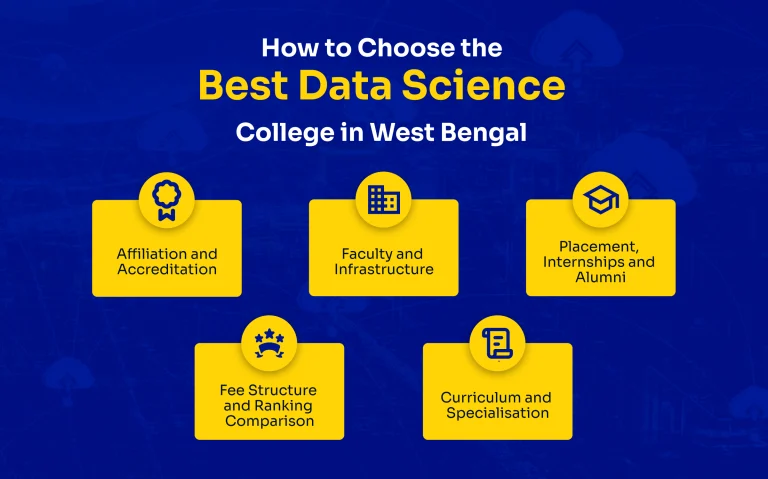
- Affiliation and Accreditation :- Check if the college has the right affiliations, like most private colleges are affiliated to MAKAUT, and government colleges require a WBJEE, JEE Main, or GATE entrance exams, and ensure that the UGC approves the college and, where applicable, the AICTE; this validates its legal recognition in India.
- Faculty and Infrastructure:- Check the faculty profile on the website of the college. Also, make a visit to the college campus or take a virtual tour to get a better understanding of the infrastructure, facilities, and laboratories of the college.
- Placement, Internships and Alumni:- Check if the college provides placement support for its students, go through the latest data of placed students, alumni success stories and alumni connections. Look, if the college provides 100% assistance in providing internships to its students to prepare them for the real world.
- Fee Structure and Ranking Comparison:- Look for the overall cost against realistic outcomes – tuition, hostel, transport, living; check for scholarships, fee waivers, or education loans to judge value for money, not just “cheap vs. expensive”. Also, compare the rankings. Institutes with NAAC grades or appearing in reputed rankings (like Google) are preferable because usually, this reflects stronger academic processes and student support.
- Curriculum and Specialisation:- Check the curriculum and specialisation so that you get a better idea of whether the college actually follows an updated curriculum, keeping up with the demands of the real world.
👉 Make an informed decision with personalised admission counselling
Conclusion
Both private and government Data Science colleges in West Bengal serve different student needs. Government colleges are suitable for those who prefer a strong academic focus and lower fees, while private colleges are better aligned with industry requirements, hands-on learning, and placement support.
Our recommendation: for students starting after 12th and aiming for practical skills, internships, and faster career entry, a well-accredited private Data Science college in West Bengal is often the more effective choice.
Ultimately, choose the option that suits your goals, learning style, and long-term plans the best.
FAQs:-
ANS:- Government Data Science colleges are state- or centrally funded and focus more on theoretical learning with low fees, while private Data Science colleges are industry-oriented, offering hands-on training, internships, and stronger placement support.
ANS:- Government colleges are better for students who prefer low fees, strong academics, and research-oriented careers, whereas private colleges are more suitable for students seeking practical skills, industry exposure, and faster job placement.
ANS:- Government Data Science colleges usually charge between ₹10,000 and ₹25,000 for the entire course, while private Data Science colleges charge higher fees ranging from ₹1.5 to ₹4 lakhs per year.
ANS:- Yes, private Data Science colleges often provide better placement support through industry tie-ups, internships, resume training, and interview preparation compared to most government colleges.
ANS:- Students should consider affiliation and accreditation, faculty quality, infrastructure, curriculum relevance, placement and internship support, fee structure, and overall value for money.