


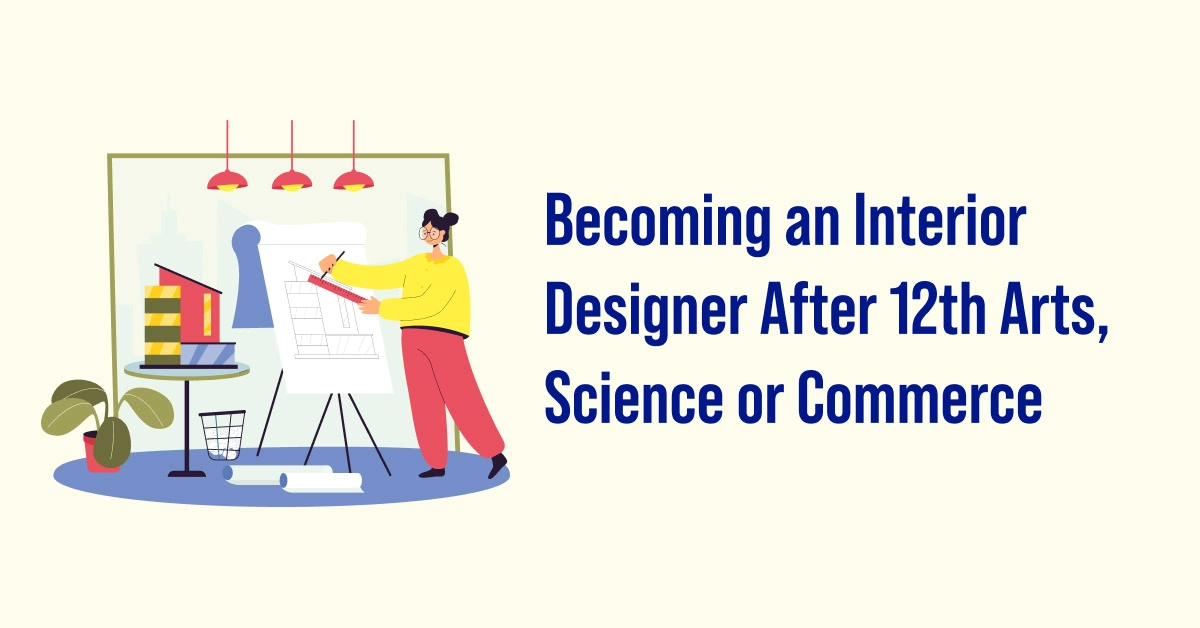

Have you ever been in a beautifully done home or store, or cafe, and thought to yourself that you could enhance its aesthetics? Or, that you too could design and style spaces, and create Pinterest-worthy interiors? Then becoming an Interior Designer might just be the right thing for you. The best thing is that you can become an Interior Designer regardless of what stream you pursued in your high school. You can choose this career after having studied Science, Arts, or Commerce.
In this article we will give you all the requisite details for you to become an Interior Designer: the skills you need, eligibility criteria, courses you can opt for, career opportunities in this field, along with salary expectations at various stages of being an Interior Designer.
Read on to find out more about how to become an Interior Designer.
What is Interior Designing? What does an Interior Designer do?
It is imperative to understand the profession before we dive into how to become an Interior Designer.
An Interior Designer makes indoor spaces aesthetically appealing, safe, and accessible by planning, designing, and executing space functionally in consultation with their clients. This includes:
- Designing residential units, homes and apartments.
- Designing office spaces.
- Planning and designing layouts for retail shops, malls, hotels, cafes, and restaurants.
- Curating furniture, fabric samples; selecting lighting and colour schemes.
- Collaborating with architects, contractors, dealers, labourers.
- Consulting with clients and incorporating their feedback to meet expectations
This field does not deal only with design and decoration; it is a combination of creative skills, technical know-how, spatial knowledge, and effective communication skills.
Can you become an Interior Designer after 12th?
Yes, you can begin your studies to become an Interior Designer after 12th. It does not matter which stream (Science, Arts, or Commerce) you pursued in your high school; in most Interior Designing courses in India there is no strict stream restriction or limitation to enroll into this course after 12th.
Students from each stream can contribute to this course. Here’s how:
Arts Student:-
If you studied fine arts, drawing or even the subjects generally associated with Humanities, you already have a distinguished base built on critical thinking, creativity, and aesthetics that help in design studies and innovations.
Science Studnet:-
Science students might find it easy to grasp technical subjects and understand structural studies, lighting, material properties and preferences, and mathematical tools for measurements and placements.
Commerce Students:-
Commerce students generally excel in business management, accounting, budgeting, client handling, people management, etc. These are often sought-after skills in this profession.
Ultimately, the process of becoming an Interior Designer remains by and large the same for everyone regardless of the stream. Once you enroll into this course, you will get the opportunity of learning every necessary point according to the course plan.
👉 Confused about eligibility? Talk to our admission counsellor and check your eligibility today.
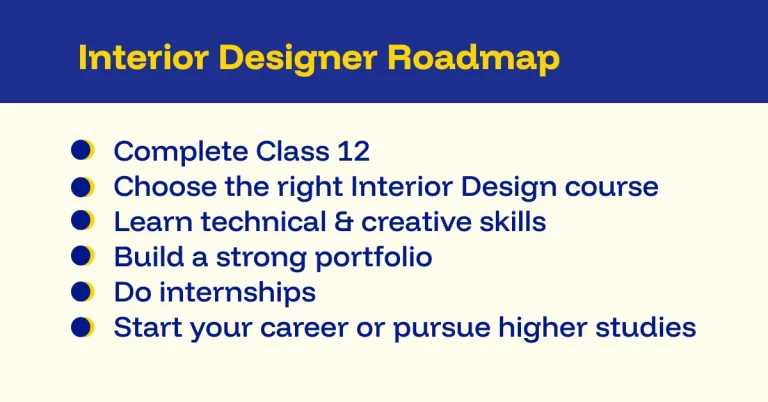
Step-by-Step Guide: How to become an Interior Designer?
Step 1: Complete your 12th standard
You must accomplish your 12th standard exams from a recognized board. Most institutes seek the following requirements:
- Minimum 50% marks (depends on individual institutions)
- No specific compulsory subjects
You can opt for specialisation as you move into professional courses.
Step 2: Choose the right Interior Design Course
The most significant step in understanding how to become an Interior Designer is to choose the right course. Below are the most common courses:
- Bachelor’s Degree in Interior Design (3-4 years)
Popular options are:
- B.DEs (Bachelor of Design – Interior Design)
- B.Sc Interior Design
- B.A. Interior Design
A Bachelor’s Degree specifically provides training in:
- Design Theory
- Spatial planning (strategic and basic process of analysing and arranging a room’s layout to maximize accessibility, functionality and aesthetic appeal)
- CAD software (a software that enables designers to visualise and create 2D and 3D plans)
- Building materials
- Lighting designs
- Furniture designs
- Diploma in Interior Design (1-2 years)
This kind of course is more practice-based and takes a shorter duration. You can opt for this course if:
- You would like hands-on training
- You want to start working early
- You have plans of doing in-depth studies later
- Certificate Course (6 months – 1 year)
This is ideal for skill enhancement and basic introduction. However, a degree or diploma is more suitable if you are aiming for career building and growth in this direction.
Step 3: Entrance Exams
While it is not necessary everywhere, a few premium institutes admit students through entrance exams. In India, the most common and popular entrance tests are:
- NID Entrance Exam for National Institute of Design
- NIFT Entrance Exam for admission to National Institute of Fashion Technology
- UCEED for entry into design programmes at various Indian Institutes of Technology.
Plenty of private institutes offer admission without entrance tests based only on 12th marks.
Step 4: Develop technical skills along with fostering a creative mindset
While fostering a creative mindset is imperative, you can truly become an Interior Designer by grounding it in technical skills.
The most relevant software tools for Interior Designers include:
- AutoCAD (Industry tool for creating 2D layouts and 3D visualisations)
- SketchUp (3D modelling tool)
- 3Ds Max (premium industry-standard software tool for 3D space visualisation)
- Revit (a powerful software used for creating intelligent and editable 3D building objects)
- Photoshop (another industry standard designer favourite that helps build realistic visualisation and moodboards)
Design software skills make you more employable.
Step 5: A Strong Portfolio
Your portfolio defines you and represents you. Be sure to include:
- Sketches and drawings
- Internship experience
- 3D models
- Mood Boards
- Academic projects
A good portfolio showcases your creativity and design potential to probable employers and clients.
Step 6: Do Internships
Internships are essential for trainee Interior Designers as they provide practical experience and industry exposure.
Internships help you understand:
- Client interactions.
- Site visits
- Real-time projects
- Budgeting
- Execution strategies
- They also give valuable networking insights.
Step 7: Start Working or opt for Higher Studies
After graduation, you can:
- Work under established interior designers
- Start your own firm
- Do freelance work
- Join architectural or design firms
- Go for Masters (M.Des or MBA in Design Management)
👉 Apply now for our Bachelor’s in Interior Design program and secure your seat for 2026 admission.
Skills Required to Become an Interior Designer
- Creativity:- You have to have an innovative and unique mindset. It is imperative that you develop a distinguished thought process.
- Communication Skills:- From client interaction to networking, everywhere your communication skills will keep you afloat.
- Technical Knowledge:- Understanding of materials, lighting, measurements, spatial planning, flow, software tools is indispensable to interior designers.
- Attention to Detail:-Your eyes must be fine-tuned to minute details as every small thing could make or mar designs and projects.
- Problem-Solving Mindset:- Each project brings its own set of challenges; it is essential that as an interior designer, you find ways to effectively navigate through issues, from space to budget limitations.
Career Opportunities After Interior Design
The next step after understanding how to become an interior designer is to explore the career opportunities in this field.
Job Roles:-
- Commercial Interior Designer: A commercial interior designer works to create functional and aesthetically appealing spaces for commercial establishments such as offices, hotels, malls, restaurants and cafes, hospitals, educational institutes, research centres, etc. They focus on building brand identity, customer experience, and devise creative designs to adhere to public safety regulations in these places.
- Residential Interior Designer: They plan and devise personalized living space for in-house settings and mostly indoor spaces, as well as residential units like apartments and complexes.
- Furniture Designer: They are exclusively specialised in designing functional, innovative, and ergonomic furniture, managing client expectations and the trends of the time. They might work independently or with companies to develop products and designs.
- Office Space Planner: This section of interior designers work exclusively for designing office space prioritising space utilisation and safety norms, while ensuring productivity, workflow efficiency and employee comfort.
- Lighting Designer: These designers engage with lighting concepts and create designs that complement and enhance ambience, functionality, and visual appeal of indoor spaces.
- Set Designer for Films, TV, or OTT: They design and build sets for the entertainment industry that are best-suited for the script’s settings, scope, and mood. The set designers work with directors and art teams to create the most effective sets.
- Sustainable Design Consultant: A rather new and emergent field in interior designing, a Sustainable Design Consultant advises energy-efficient, eco-friendly design solutions, aiming to reduce environmental detriment while maintaining aesthetic standards.
- Retail and Exhibition Designer:– They make engaging and attractive spaces for retail and exhibition set-pieces in order to catapult brand image and draw customers.
Work Area
Interior Designers often find gainful employment in:
- Architecture firms
- Design studios
- Real Estate
- Corporate offices
- Hotels and hospitality chains
There are also professionals who opt for entrepreneurship or freelancing or contractual work, which would often offer a higher income potential.
Salary of an Interior Designer
The salary offered in India depends on variables like qualification, experience, location:
- Freshers: INR 2.5 – 4 LPA
- Mid-Level (3-5 years): INR 5 -8 LPA
- Experienced: INR 10 LPA and above
- Freelancers and entrepreneurs might earn more based on projects.
👉 Download our Interior Design course brochure to explore curriculum, fees, and career opportunities.
Is Interior Design a Good Design Career Option?
Interior Designing is one of the fastest growing industries in India, with research reports suggesting how it is projected to reach USD 65.01 billion by 2031 and is currently pegged at USD 35.48 billion in 2026 (source: ). Its growth is complimented by:
- Rapid urbanisation
- Rising real estate value
- Demand for personalised space
- Expansion of office and hospital spaces, and their modernisation.
Concluding Thoughts: Your Dream Career is just one decision away!
Whichever stream you pursued in 12th – be it Arts, Science or Commerce – that would not be an impediment in your way to become an interior designer. Interior Designing is not just about decoration: it is about the manifestation of lifestyle choices and the projection of personalities. You get to steer these dreams and give concrete shape to these abstract aspirations through sheer dedication, optimum skill sets and people management. If you are passionate about such a dynamic and creative career, start exploring courses now!
📞 Book a free counselling session today or apply online to secure your seat.
FAQs:-
ANS:- The course as well as the profession do not require advanced mathematical skills; basic to intermediate acumen is sufficient.
ANS:- Yes, they can easily apply for and pursue this course.
ANS:- Drawing or sketching skills definitely helps, but one can always cultivate the requisite quantum during the course. Moreover, software and technological knowledge are equally important.
ANS:- Bachelor’s degree holders typically take 3-4 years; and, diploma courses offer early access to industry.